

Live Casino

Live Casino

How to Win at Live Blackjack with Smarter Advanced Decisions

Live blackjack looks simple until several decisions arrive at once. You need to read the dealer’s upcard, evaluate your hand, understand the table rules, choose the right stake, and avoid emotional reactions after a bad result.

Learning how to Win at Live Blackjack is therefore less about finding a secret betting system and more about consistently making decisions with stronger expected value. You cannot remove the casino’s mathematical advantage completely in ordinary play, but you can reduce unnecessary losses by combining correct strategy, rule selection, and disciplined session management.

Start With the Table Rules, Not the First Hand

Advanced blackjack decisions begin before you place a bet. Two live tables can look almost identical while producing different mathematical expectations because their rules are different.

Look Closely at Blackjack Payouts and Dealer Rules

A table paying 3:2 for blackjack is generally preferable to a weaker payout structure. You should also check whether the dealer stands or hits on soft 17, whether doubling after splitting is allowed, and how many times pairs can be re-split.

Rule variations directly change expected player return, which means table selection is part of the strategy rather than a cosmetic choice.

The number of decks matters too. With otherwise comparable rules, fewer decks generally improve the player’s mathematical position slightly.

A skilled player therefore makes the first important decison before any cards are dealt.

Treat Basic Strategy as Your Default Operating System

Advanced play does not mean abandoning basic blackjack strategy. It means understanding it well enough that ordinary decisions become automatic.

Basic strategy compares the player’s total with the dealer’s visible card and identifies the mathematically preferable action for that particular rule set. Correct charts vary depending on factors such as deck count and whether the dealer hits or stands on soft 17.

Stop Playing According to Fear

Consider a hard 16 against a dealer 10. Many casual players stand because drawing another card feels dangerous. Yet blackjack decisions should be based on expected outcomes rather than which action feels safer.

The same logic applies when doubling 11, splitting pairs, or hitting soft hands. Advanced players accept that the mathematically correct decision can still lose the current hand.

That distinction is crucial. Strategy optimises repeated decisions; it does not predict individual cards.

Think in Expected Value Instead of Winning Streaks

One of the biggest upgrades in blackjack thinking is moving from outcome-based thinking to expected-value thinking.

Imagine you make a mathematically correct double-down and lose immediately. The result is negative, but the decision itself may still have been correct.

Judge Decisions Over Hundreds of Hands

Short sessions contain substantial variance. Blackjack can produce long winning and losing sequences even when every choice is mathematically sound. Analysis published by Wizard of Odds illustrates meaningful per-hand variance even in games with relatively low theoretical house edges.

For this reason, advanced players mentally separate three things: decision quality, short-term result, and long-term expectation.

Do not change a sound strategy because you lost four hands in a row. That reaction replaces mathematics with emotion and creates avoidable probablity errors.

Use Dealer Upcards to Control Aggression

The dealer’s visible card should influence how aggressively you play.

A dealer showing a weak card such as 4, 5, or 6 has a different probability profile from one showing a 9, 10, or ace. Basic strategy incorporates these differences into hitting, standing, splitting, and doubling decisions.

Let the Dealer’s Weak Position Work for You

When the dealer is vulnerable, you often do not need to chase a stronger total aggressively. Conversely, when the dealer shows a strong upcard, passive play with weak totals may provide poor expected value.

This does not mean simply “stand against low cards and hit against high cards.” Soft totals, pairs, doubling rules, and surrender options create important exceptions.

The advanced skill is recognising the structure behind the chart rather than memorising random commands.

Handle Insurance and Side Bets Carefully

Live blackjack tables often include side wagers because they add variety and larger potential payouts. They do not automatically improve the core game’s value.

Insurance, for example, is a separate wager offered when the dealer shows an ace. It pays 2:1 when the dealer has a ten-value hole card.

For players who are not using valid count-based information, standard strategy generally rejects insurance because its expected return is unattractive. Single-deck analysis, for example, shows a substantial house edge on the insurance wager.

Separate Entertainment Bets From Strategy

Side bets should be evaluated seperately from your main blackjack hand.

A large jackpot or flashy payout does not tell you the wager’s expected value. If your goal is efficient play, additional wagers should have a clear mathematical reason rather than simply making the table more exciting.

Control Bet Size Before Variance Controls You

Good strategy cannot protect a bankroll that is being wagered too aggressively.

Suppose your session bankroll is $500. Betting $100 per hand gives you only five full starting bets before doubles or splits are considered. A small run of ordinary losses can therefore create serious pressure.

Betting $10 or $15 produces a very different risk profile.

Avoid Emotional Bet Escalation

Increasing stakes because you are behind is not an advanced strategy. Neither is doubling a bet simply because several losses “must” be followed by a win.

Independent hands do not owe you a recovery.

Instead, decide your normal betting unit before playing and establish a maximum session exposure. This creates consistancy when emotions become stronger after a losing sequence.

Make Live-Table Pace Part of Your Strategy

Live blackjack introduces a human dealer, betting countdowns, chat, other players, and a continuous video environment. Those details can distract you from the actual decision.

Use the available decision time deliberately. Check your total, identify whether it is hard or soft, read the dealer’s upcard, and confirm whether doubling or splitting changes the situation.

Speed is not the objective. Accuracy is.

The strongest live blackjack player at the table is often not the person making the fastest decisions, but the one making the fewest avoidable mistakes.

To Win at Live Blackjack more effectively, focus on the parts of the game you can actually control: table rules, basic strategy, expected-value decisions, bet sizing, and emotional discipline. None can guarantee a profitable session, but together they create significantly better decision quality. Before your next session, study the exact rules and use the matching strategy chart rather than relying on instinct.

Live Casino

How Live Casino Streaming Works Behind the Scenes

A live casino table may look simple from the player’s screen. A dealer handles physical cards or spins a roulette wheel, bets appear on a digital layout, and the result is confirmed within seconds.

Behind that experience is a coordinated system involving cameras, microphones, game-management software, streaming servers, surveillance, and transaction processing.

Understanding how live casino streaming works behind the scenes reveals that the video feed is only one part of the operation.

The platform must also receive bets, close the wagering window at the correct moment, record the physical result, calculate payouts, and update many player accounts simultaneously.

Unlike a fully automated casino game, a live table combines real equipment and human procedures with digital interfaces.

Industry standards describe live games as real-time audiovisual experiences in which a platform receives player instructions and records gaming activity through control servers.

The entire process must remain synchronized so that no one can place a wager after the outcome becomes known.

The Live Casino Studio

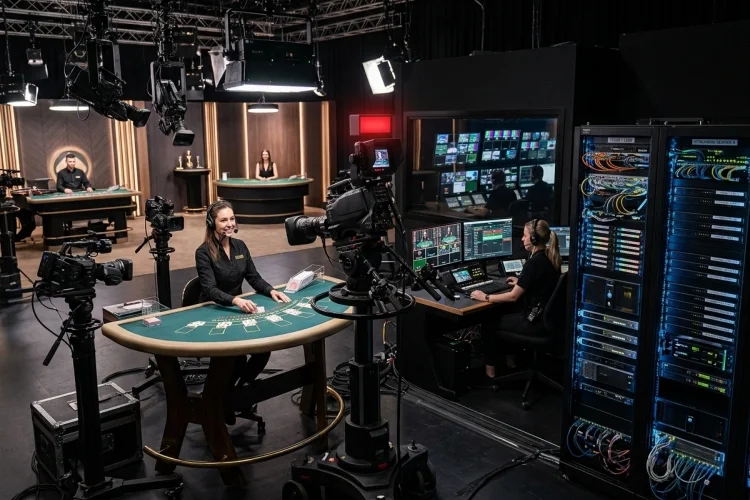
Most live dealer games are broadcast from purpose-built studios that operate like a combination of a casino floor and television production facility. Each table has approved gaming equipment, professional lighting, microphones, cameras, and a workstation used to manage the round.

Studios may contain standard shared tables or dedicated environments created for one operator. Dedicated rooms can use customized interiors, branded furniture, localized dealers, and digital backgrounds. Evolution states that its dedicated setups can include physical sets, three-dimensional environments, chroma-key backgrounds, and multilingual teams.

Access to operational areas is normally restricted. Dealers, supervisors, technicians, security personnel, and production staff have separate responsibilities.

Cameras Capture the Physical Game

Multiple cameras allow the player to see the dealer, betting area, cards, wheel, or dice from appropriate angles. A roulette production may switch from a wide view of the table to a close-up of the ball as it approaches the numbered pockets.

Evolution describes dedicated roulette setups using three or more high-definition cameras, with configurable angles, cuts, and sequences. Some specialized baccarat products use many additional cameras to show the handling and revealing of cards.

The video director or automated production system selects the most useful view without interrupting the physical game. Audio is captured separately and synchronized with the picture.

The Game Interface Connects Players to the Table

The video sits behind a digital user interface containing betting controls, balances, timers, histories, and game information. Players do not send physical chips to the studio. Instead, the interface transmits electronic wagering instructions to the casino platform.

During roulette, for example, the player selects a chip value and places it on a digital representation of the table. In blackjack, the interface also sends decisions such as hit, stand, double, or split.

Evolution explains that live casino software lets users place bets, make game decisions, and communicate through an interface while watching the studio stream on a phone or computer.

How Bets Reach the Game Server

When a player confirms a wager, the platform checks the account balance, table limits, betting status, and transaction time. An accepted bet is recorded before the betting window closes.

The server must prevent access to the result before wagers are finalized. GLI-19 also states that live systems should record gaming activity and results through simulcast control servers while providing players with real-time audiovisual access.

After “no more bets” is announced, the interface disables further wagering. The physical action can then determine the result without accepting late entries.

How the Physical Result Becomes Digital Data

Once the dealer completes the round, the outcome must be entered into the gaming platform. The exact method depends on the game and equipment.

Cards may be registered as they are dealt through approved reading technology or confirmed through the dealer’s game-management workstation.

Roulette equipment can communicate the winning number to the control system, while supervisors may verify unusual or disputed outcomes.

The result is recorded before being posted to the player interface. GLI standards also require mechanisms for authorized personnel to void a result when a genuine game irregularity makes that necessary.

Video Compression and Low-Latency Delivery

Raw studio video is too large to send directly to thousands of devices. It is encoded and compressed before being distributed through streaming infrastructure.

The system may provide different video-quality levels for different devices and connection speeds. A desktop user with fast broadband may receive a sharper feed than someone using a weak mobile network.

Low latency is important because the interface and studio action must appear closely synchronized. Even so, a short delay may exist between the physical table and the player’s screen.

Technical standards therefore require operators to disclose minimum connection requirements and provide equivalent-quality feeds when communications begin or reconnect.

Payouts and Account Updates

After the result is verified, the game engine compares it with every accepted wager. Winning bets are calculated according to the published paytable, while losing stakes remain deducted.

Account balances and betting histories are then updated. This settlement may happen quickly, although the next round should not begin until the previous game has been properly recorded.

If a player’s connection fails after the bet has been accepted and the person can no longer influence the outcome, UK Gambling Commission guidance says that the result should normally stand.

When an interruption occurs before an outcome is generated in a single-stage game, the deducted stake should generally be returned.

Surveillance and Quality Control

Live casino studios use surveillance and recording systems to monitor game procedures, equipment, dealer activity, and technical events. GLI-19 calls for continuous recordings detailed enough to reconstruct games, confirm whether procedures were followed, and review complaints.

Licensed operations may also be independently audited. The UK Gambling Commission requires live dealer operations under its authority to be fair and independently auditable.

Recordings and transaction logs help distinguish a streaming problem from an incorrect result or unaccepted wager.

Live casino streaming combines physical gaming equipment with television production, interactive software, secure servers, transaction records, and real-time account settlement.

Cameras and microphones capture the table, while the gaming interface sends player decisions and accepted bets to the platform. The result must be verified and stored before payouts are calculated.

Surveillance recordings and technical logs provide evidence when a disconnection or disputed round occurs. Before joining a live table, verify the operator’s licence, read its interruption policy, and confirm the betting limits.

Use a stable connection, avoid last-second wagers, and set clear spending and session limits before the broadcast begins.

Live Casino

The Advantages and Limitations of Live Dealer Games Explained

Live dealer casino games sit between traditional casino tables and fully digital online games. Instead of watching computer-generated cards or wheels, players connect to a video stream showing a real presenter, physical gaming equipment, and a studio designed to resemble a casino floor.

This format has become popular because it brings human interaction into online blackjack, roulette, baccarat, game shows, and other table games.

Professional studios may use several high-definition cameras, real-time betting interfaces, chat functions, statistics, and transaction histories to create an immersive experience on desktop and mobile devices.

However, realism introduces practical limitations. Live rounds depend on human dealing, studio schedules, available seats, betting windows, streaming quality, and the player’s internet connection. Some tables may also carry minimum wagers that are unsuitable for smaller budgets.

Understanding the advantages and limitations of live dealer games helps players decide whether the format matches their preferred pace, device, budget, and expectations.

What Are Live Dealer Games?

A live dealer game is conducted by a real dealer or presenter and streamed from a casino floor or specialist studio. Players use an on-screen interface to place digital wagers while watching the physical cards, wheel, dice, or other equipment through a video feed.

The system connects studio activity with the online betting platform. GLI technical guidance says live services should provide real-time audiovisual access and identify information such as the game, table, time, and location.

It also recommends recording live play so disputed rounds can be reconstructed and reviewed.

Advantage: A More Authentic Casino Atmosphere

The strongest appeal is the sense of participating in a real table game. Players can see cards being dealt, roulette balls spinning, and presenters managing each round instead of relying entirely on digital animation.

Live studios often use professional lighting, themed backgrounds, multiple cameras, and trained hosts. Pragmatic Play describes its live platform as using professional dealers, advanced broadcasting technology, and several 4K-quality camera views.

This atmosphere can make familiar games easier to recognize for people accustomed to physical casinos. It also adds natural pauses and human presentation that automated games may not provide.

Advantage: Interaction With Dealers and Other Players

Many live games include chat tools that allow users to communicate with the presenter or view messages from other participants. ONE Blackjack, for example, offers chat with the host, other players, and live support alongside detailed betting history.

The interaction is limited compared with sitting at a physical table, but it can reduce the solitary feeling associated with standard online gaming. Dealers may welcome participants, explain procedures, or announce results as the round develops.

Dedicated studios can also provide localized presenters, languages, uniforms, and environments. Evolution states that its dedicated tables may use culturally and linguistically relevant dealers and personalized interaction.

Advantage: Visible Procedures and Audit Controls

Watching a real table can make the dealing procedure more visible. Players may observe shuffling, card distribution, wheel movement, and the dealer’s actions through several camera angles.

Visibility alone does not prove that an operator is trustworthy. The stronger protection comes from licensing, documented procedures, supervision, and independent auditing.

The UK Gambling Commission requires regulated live dealer operations to be fair and independently auditable. Its guidance also calls for trained croupiers, commercial-quality equipment, surveillance, secure access, and game logs that can be analyzed for irregularities.

Advantage: Convenient Access to Table Games

Live tables allow users to experience dealer-led blackjack, baccarat, roulette, and game-show formats without travelling to a casino venue. Some providers broadcast selected tables around the clock and make them accessible through desktop and mobile browsers.

Online interfaces may also provide features that are difficult to reproduce at a physical table. Examples include saved bets, detailed statistics, zoom functions, betting histories, and automated decision tools.

Availability still differs by jurisdiction. Online casino regulation may operate nationally, regionally, or through market-specific licences, so a game offered in one country may be unavailable in another.

Limitation: Slower and Less Flexible Gameplay

Live rounds must allow time for bets to be placed, equipment to be handled, and results to be confirmed. This generally makes the experience slower than fully automated casino software.

Even products marketed as speed games retain structured rounds. Pragmatic Play states that its Speed Roulette averages approximately 25 seconds per round, while its accelerated blackjack and baccarat products shorten dealing and decision times.

Some players appreciate this pace because it encourages more deliberate decisions. Others may find the waiting periods inconvenient, especially when sharing a blackjack table with participants who use their full decision time.

Limitation: Dependence on Internet and Streaming Quality

Live games require a continuous flow of video, audio, betting data, and result information. Weak Wi-Fi, limited mobile data, device performance, or network congestion can cause freezing, delayed pictures, or interrupted wagers.

GLI guidance states that live providers should establish and disclose a minimum connection requirement. It also recommends procedures for reconnecting interrupted feeds and managing disruptions to video, audio, or data streams.

A delayed image does not necessarily mean the actual game has stopped. The studio may continue operating while the player’s device struggles to display the stream, making a reliable connection essential.

Limitation: Table Limits, Seats, and Fixed Betting Windows

Every table has minimum and maximum wagers. These boundaries may be unsuitable for players who want very small stakes or unusually high limits.

Blackjack tables may also have a limited number of seats. Some scalable versions allow many users to make separate decisions from one position, while VIP products may intentionally restrict participation to one or only a few players.

Betting windows can be short. Once the countdown closes, late wagers are rejected even when a player intended to repeat a previous bet. Reviewing the interface before the first paid round reduces hurried mistakes.

Limitation: Realism Does Not Remove Gambling Risk

A visible dealer and professional studio can make a game feel more trustworthy, but they do not remove the house advantage or guarantee positive results. Physical cards and wheels still produce uncertain outcomes.

The social atmosphere may also encourage longer sessions if players stop noticing elapsed time. Reality-check tools can display session duration and give users an opportunity to exit or review their account history.

WHO warns that gambling can affect finances, health, relationships, and household spending. A fixed entertainment limit remains necessary regardless of how authentic the game appears.

Live dealer games offer realistic presentation, human interaction, visible procedures, and convenient access to familiar casino tables.

They can feel more engaging than automated games and may include useful features such as statistics, chat, multiple cameras, and transaction histories.

Their limitations include slower rounds, connection requirements, fixed betting windows, table limits, seat availability, and continued exposure to gambling losses.

Before joining a table, verify the operator’s licence, test the stream, read the rules, and confirm the minimum wager. Activate a time reminder and establish a strict entertainment budget before betting.

Choose live play only when its pace, technical requirements, and financial limits suit your circumstances.

Live Casino

Live Casino Etiquette Every Player Should Know Before Joining

A live casino table may look similar to a traditional casino floor, but players participate through a digital interface. A real dealer handles physical cards, wheels, or other equipment while participants place bets using buttons and virtual chips on their screens.

This combination creates a unique set of expectations. Players must follow the game’s betting timer, communicate appropriately through chat, understand the dealer’s role, and avoid disrupting other participants.

Good behavior cannot improve the odds, but it can make the experience smoother and reduce mistakes.

Learning live casino etiquette every player should know is especially useful for beginners who may feel pressured by countdowns, unfamiliar side bets, or a fast-moving table.

Etiquette is not only about politeness. It also includes checking wagers carefully, respecting the published rules, protecting personal information, and knowing when to leave.

Before joining, verify that the operator is licensed in the relevant jurisdiction and set an affordable spending limit. Local laws and platform rules can differ, so always review the casino’s terms before playing.

Observe the Table Before Placing a Bet

There is no need to start wagering immediately after entering a live room. Watch one or two complete rounds to understand the betting window, dealer announcements, settlement process, and location of important controls.

Confirm the minimum and maximum stakes before participating. A table that looks affordable may contain optional side bets that substantially increase the total amount placed during each round.

Live casino versions can also use different rules despite sharing the same game name. Regulatory standards in Great Britain require operators to make game rules, payouts, and information about the likelihood of winning available to customers.

Place Your Bet Before the Countdown Ends

Live tables use a limited betting window so all wagers are recorded before cards are revealed or a wheel result becomes known. Select the chip value, place it on the correct position, and verify the total while time remains.

Avoid tapping repeatedly during the final second. Internet latency may cause a bet to arrive after the server has closed the round, even when the countdown still appears active on your screen.

A regulated remote platform should clearly display how much money is being wagered, including any conversion into chips or credits. Checking that figure before confirmation is both good etiquette and sensible financial control.

Respect the Dealer’s Role

The dealer is responsible for conducting the game according to documented procedures. Depending on the table, this may include dealing cards, spinning a wheel, announcing results, and preparing the next round.

The dealer does not personally choose who wins. British live dealer standards require trained croupiers, supervised operations, secure equipment, and video surveillance sufficient to confirm whether procedures were followed.

Do not blame or insult the dealer after an unfavorable result. Losing is part of the mathematical uncertainty of casino games, not evidence that the dealer has targeted an individual participant.

Use the Chat Feature Politely

Live chat allows players to greet the dealer, ask a brief game-related question, or interact with other participants. Keep messages respectful, concise, and relevant to the table.

Avoid offensive language, repeated complaints, promotional messages, or requests for personal information. Never share your full name, address, phone number, password, payment details, or verification code in a public chat.

The dealer may not answer every message, especially at a busy table. Managing cards, chips, announcements, and game procedures takes priority over conversation.

Do Not Pressure Other Players

At some live blackjack tables, several participants may make their own decisions during the same round. Another player might hit, stand, split, or double in a way you would not choose.

Do not criticize that person or claim that their decision caused your loss. Cards are dealt according to the table procedure, and each participant is entitled to make the permitted choices for their own hand.

The same principle applies to shared betting and bet-behind formats. Understand whether you control the decision or are following another seat before committing money.

Handle Technical Problems Calmly

A frozen video stream does not necessarily mean the round has stopped. The studio and casino server may continue recording accepted wagers even when your device temporarily loses the feed.

Do not immediately repeat the bet. Reconnect, review your balance, and check the game-history page to determine whether the original wager was accepted and settled.

Technical standards for interrupted remote gambling require systems to retain enough information to complete, restore, or appropriately void affected games. If the result remains unclear, contact official support with the table name, time, wager amount, and round reference.

Leave the Table Without Chasing Losses

You may leave after any completed round. There is no requirement to stay until the dealer changes, a card shoe ends, or a losing streak reverses.

Do not increase the stake because a result appears overdue. Previous Banker hands, red roulette numbers, or dealer wins do not force the next round to produce the opposite outcome.

Set a spending limit before starting rather than negotiating with yourself during play. GambleAware recommends choosing a limit in advance and using account tools, separate funds, written reminders, or support from someone trusted to help maintain it.

Live casino etiquette combines courtesy, attention, and financial discipline. Observe the table before betting, respect the countdown, verify every stake, and communicate politely with the dealer and other participants.

Technical issues should be handled through game history and official support rather than repeated bets or angry chat messages. Other players are entitled to make their own permitted decisions, and no one is obligated to remain at a table after a round ends.

Before your next session, verify the operator through an official licensing register, read the table rules, and write down your money and time limits.

Leave as soon as either limit is reached. A respectful, controlled approach makes live casino play easier to understand, even though it cannot remove the risk of losing.

Live Casino

What to Expect During Your First Live Casino Session

Entering a live casino room for the first time can feel more intimidating than opening a regular online game.

A real dealer appears on the screen, other players may be placing bets, a countdown is running, and several buttons or betting areas compete for your attention. Fortunately, the basic experience is easier to understand once you know how a round is organized.

Live casino games combine real-time video streaming with an online betting interface. The dealer handles physical cards, a roulette wheel, dice, or other equipment, while players submit wagers through a computer or mobile device.

Unlike virtual casino games, the outcome is normally produced by equipment inside a studio rather than an animated random number generator.

Knowing what to expect during your first live casino session can help you avoid rushed bets and interface mistakes. It cannot guarantee a winning result, but it can make the experience more controlled.

Before participating, confirm that gambling is legal in your location, verify the operator’s licence, and set a spending limit using only money you can afford to lose.

Choosing Your First Live Casino Table

The live lobby will usually display multiple blackjack, roulette, baccarat, poker-style, and game-show tables. Each table may have different minimum bets, languages, rules, dealers, and round speeds.

Start with a familiar game and a low minimum stake. Standard blackjack, European roulette, or traditional baccarat is normally easier to follow than a version containing multipliers, jackpots, or numerous side bets.

Live casino providers now offer both traditional table games and modified variations. The existence of many formats makes checking the individual rules essential, even when you already recognize the game’s name.

Understanding the Live Game Screen

The screen is generally divided into two areas. One section shows the dealer and physical table, while the other contains betting controls, your balance, available chips, game rules, and previous results.

Regulated remote systems should clearly show the amount being wagered before the player confirms a bet. This includes the unit stake, total stake, and any conversion between money and digital chips or credits.

Spend a few rounds watching before betting. Identify the countdown timer, minimum and maximum limits, confirmation indicator, and button used to repeat or clear wagers.

Placing a Bet Before the Timer Ends

Every live round includes a limited betting window. You select a chip value and place it on the appropriate position before the countdown reaches zero.

In roulette, you may place chips on numbers, colors, columns, or other sections of the layout. Baccarat normally offers Player, Banker, Tie, and optional side bets. Blackjack requires an initial wager before cards are dealt, followed by possible decisions such as hit, stand, double, or split.

Once the dealer announces that betting is closed, new wagers are rejected. Avoid placing chips during the final second because a slow connection or delayed tap may prevent the bet from registering.

What the Dealer Does During a Round

The dealer manages the physical part of the game. Depending on the title, this can involve dealing cards, spinning a roulette wheel, announcing results, collecting losing wagers, and starting the next betting period.

Live dealer outcomes use physical equipment rather than the same process applied to RNG-driven virtual tables. Regulators may require controls covering the supply, installation, maintenance, and continued operation of cards, roulette wheels, and other devices.

The dealer does not usually control your account balance or decide whether an individual player wins. The digital system records accepted wagers and settles them according to the recognized result.

Interacting Through Live Chat

Many live games include a chat window. Players may greet the dealer, ask a simple question, or comment on the game as long as the platform permits it.

The dealer may respond verbally, but cannot provide personalized betting advice or alter the rules. Large tables can contain many participants, so not every message will receive a response.

Keep messages polite and relevant. Avoid abusive language, requests for personal information, or accusations based only on losing results. Licensed live dealer operations are expected to be fair and independently auditable rather than dependent on the dealer’s personal preference.

Expect a Different Pace From Virtual Games

Live games normally move at the speed of the dealer and physical equipment. This creates natural pauses for betting, dealing, spinning, and payout settlement.

Some tables are specifically designed for faster play. For example, one provider describes its Speed Baccarat rounds as approximately 27 seconds compared with around 48 seconds for its standard version.

Faster tables allow more wagers within the same period, potentially increasing total spending. Beginners may find standard-speed games easier because they provide more time to check the stake and understand each result.

Handling Disconnections and Interrupted Rounds

A slow internet connection may cause frozen video, delayed audio, or a temporary disconnection. The video stream and betting interface may not always fail at exactly the same time.

If your wager was accepted before the connection dropped, the round may continue and be settled normally. Check the game history or account transaction page after reconnecting rather than immediately placing the wager again.

Regulatory standards for interrupted gambling require systems to retain enough information to restore or settle eligible games appropriately. Depending on the situation, the wager may be completed or voided and returned.

Setting Limits Before the Session

Live dealers and social interaction can make time pass quickly. Decide on both a financial limit and session duration before opening the table.

GambleAware advises setting a spending limit in advance because making that decision during play can be more difficult. Online account tools, separate entertainment funds, and written limits can provide additional control.

Do not increase your budget after losing or continue because the dealer is about to change. A new shoe, dealer, or roulette spin does not guarantee better results.

Your first live casino session will normally involve choosing a table, reviewing its limits, watching a timed betting phase, and observing a dealer operate real gaming equipment.

The interface records your wagers and balance, while the live stream presents each result in real time.

Begin by watching several rounds without betting. Read the rules, identify the total stake, and choose a standard-speed table with affordable limits. Prepare for occasional streaming delays and check transaction history whenever a round appears interrupted.

Most importantly, decide how much money and time you will spend before starting. Leave when either limit is reached, regardless of the result.

Live casino gambling should remain optional entertainment, never a strategy for recovering losses or producing regular income.