Casino Games

How to Choose Casino Games Using House Edge and Volatility

Choosing a casino game based only on the biggest potential payout is a bit like choosing an investment based only on its best possible outcome.

Read More
Online Slots

How to Play High-Volatility Slots Without Draining Your Bankroll

High-volatility slots are built for players who can tolerate long quiet stretches in exchange for the possibility of much larger payouts. That sounds exciting, but

Read More
Table Games

Play Roulette Strategically With Smarter Bet Coverage and Probability

Roulette gives you a strange kind of freedom: one spin can be covered with a single chip or spread across half the layout. That flexibility

Read More
Casino Games

How to Choose Casino Games Using House Edge and Volatility

Choosing a casino game based only on the biggest potential payout is a bit like choosing an investment based only on its best possible outcome. The missing piece is risk.

A smarter way to Choose Casino Games is to compare two separate mathematical ideas: house edge and volatility. House edge describes the casino’s average advantage over repeated wagers, while volatility describes how widely short-term results can move. Looking at both gives you a better picture of expected cost, bankroll pressure, and what the session may actually feel like.

Start With House Edge as Your First Filter

House edge measures average expected loss relative to the amount initially wagered. It gives players a useful way to compare the theoretical cost of different games and bets.

Suppose Game A has a 1% house edge and Game B has a 5% edge.

Turn Percentages Into Expected Money

Across $1,000 of comparable wagering, a 1% edge represents roughly $10 in theoretical expected loss. A 5% edge represents about $50.

Neither number predicts your actual session. You might win on the 5% game and lose heavily on the 1% option.

The difference becomes meaningful over repeated play.

That makes house edge an excellent starting point when you compair casino games, especially when several versions of the same game are available.

Add Volatility to Understand the Journey

House edge tells you where the mathematical average points over time. Volatility tells you how rough the path toward that average can be.

The UK Gambling Commission describes highly volatile games as potentially containing very large but rare prizes. Lower-volatility games tend to involve smaller, more frequent outcomes and a narrower range of short-term results.

Similar Expected Cost Can Feel Completely Different

Imagine two hypothetical games with roughly the same long-term house advantage.

Game A produces many relatively small wins and losses. Game B generates frequent losing rounds but occasionally delivers a much larger payout.

The mathematical cost may be similar, while the bankroll experience is completely different.

Players wanting steadier sessions may prefer the first profile. Someone comfortable with deeper drawdowns may accept the second.

Neither volatility level is automatically better. It describes a different varaince profile.

Compare Blackjack by Rules, Not Just Game Name

Blackjack is a good example of why simply saying “I choose blackjack” is not enough.

The exact rules influence the house edge.

Wizard of Odds’ calculator changes its house-edge estimate based on variables such as deck count, whether the dealer hits or stands on soft 17, doubling rules, surrender availability, and other table conditions.

Player Decisions Also Matter

Blackjack house-edge estimates generally assume correct or near-correct strategy.

A favourable table can therefore become less attractive if you regularly make incorrect hitting, standing, splitting, or doubling decisions.

This creates two filters.

First, find favourable rules. Second, determine whether you can execute the appropriate basic strategy accurately.

A low theoretical edge is useful only when the assumptions behind it are reasonably satisfied.

Look at the Individual Bet in Baccarat

Baccarat has simple gameplay, but the main wagers do not have identical mathematics.

For a standard eight-deck game, Wizard of Odds calculates about 1.06% house edge for Banker, 1.24% for Player, and 14.36% for an 8-to-1 Tie bet.

One Table Can Contain Very Different Risk

This comparison is valuable because it shows why players should evaluate individual bets rather than just game categories.

A Banker wager and a Tie wager happen at exactly the same baccarat table.

Yet their expected costs are dramatically different.

Tie also produces a more volatile experience because it wins far less frequently while offering a much larger payout.

If your aim is to minimise mathematical disadvantage and manage bankroll swings, repeatedly choosing the high-payout option simply because it feels more exciting can work against both goals.

Check the Roulette Wheel Before Choosing a Bet

Roulette illustrates another useful principle: game variation can matter more than betting creativity.

Standard American double-zero roulette has a house edge of approximately 5.26% on most conventional bets.

Single-zero variants generally provide better mathematics because they remove the additional 00 outcome working against most wagers.

Coverage Changes Volatility More Than the Edge

Within a standard wheel, a single-number bet and an even-money colour wager produce very different short-term experiences.

A straight-up number loses most spins but pays substantially more when successful. Red or black wins far more frequently but pays only even money.

Changing coverage therefore alters hit frequency and session volatility.

It does not necessarily create a better expected return.

This is why an informed player evaluates the wheel first and then chooses a bet type according to desired risk.

Do not spend twenty minutes searching for a supposedly lucky number while ignoring a worse wheel configuration.

Treat Slots Differently From Table Games

Slots usually present their mathematics through RTP rather than a traditional house-edge percentage.

A theoretical RTP of 96%, for example, corresponds conceptually to a 4% theoretical house margin.

But RTP does not tell you how that return is distributed.

Volatility Becomes Especially Important

The UK Gambling Commission notes that RTP is averaged over a large number of games and that ordinary sessions can vary because of normal volatility.

A high-volatility slot may concentrate more of its theoretical return in rare, large prizes. A calmer game might provide smaller rewards more regularly.

So when you Choose Casino Games across both tables and slots, avoid making direct comparisons using RTP or house edge alone.

Ask what the expected cost is, how quickly outcomes fluctuate, and whether your bankroll can tolerate that distribution.

Match Volatility to Your Bankroll

A theoretically efficient game can still be a poor choice if your stake is too large.

Suppose you have a $500 bankroll.

A $50 base wager gives you only ten starting betting units. A $5 wager provides 100.

Unit Depth Matters During Losing Runs

The lower stake does not change the game’s probabilities.

It changes how much damage each losing outcome can cause.

This becomes especially important when using high-variance bets. If a game regularly produces long sequences of losses before larger wins, a shallow bankroll can disappear before the payout profile has much chance to unfold.

Think about the ratio between stake and available capital before focusing on maximum payouts.

This simple calcuation often tells you more about practical risk than the casino game’s headline prize.

Include Turnover in Your Decision

A low house edge can still become expensive when wagering volume gets large.

Suppose a game carries a 1% theoretical edge.

At $500 of total wagering, expected cost is roughly $5. At $10,000, it rises to around $100.

The UK Gambling Commission calculates actual RTP using total wins divided by total wagering turnover, demonstrating how central wagering volume is to long-run game performance.

Faster Games Increase Opportunities to Bet

Two games with identical mathematical edges can create different exposure if one produces far more wagering decisions per hour.

So your comparison should include house edge, volatility, average stake, and expected volume.

A good percentage does not automatically mean an inexpensive session if you repeat the wager hundreds of times.

Build a Simple Game-Selection Framework

Before joining a game, check its mathematical cost first.

Then evaluate its volatility, exact rules, payout structure, and the amount you plan to risk per decision.

Casino information should help players make informed decisions about rules, prizes, and likelihood of winning, which is also the purpose behind the UK Gambling Commission’s game-information requirements.

Finally, ask whether the game fits what you actually want.

If bankroll stability matters, lower-edge and less-volatile wagers may be preferable. If you deliberately accept large swings for entertainment, higher volatility may fit—but size the stake accordingly.

The best way to Choose Casino Games is to combine house edge with volatility rather than relying on either metric alone. House edge shows theoretical cost, while volatility reveals how unpredictable short-term results can be.

Compare exact rules, individual wagers, bankroll units, and turnover before playing. Start with the mathematics, then choose the risk profile that genuinely fits your budget and session goals.

Online Slots

How to Play High-Volatility Slots Without Draining Your Bankroll

High-volatility slots are built for players who can tolerate long quiet stretches in exchange for the possibility of much larger payouts. That sounds exciting, but it also means a poorly sized stake can make a bankroll disappear surprisingly fast.

Learning how to Play High-Volatility Slots responsibly starts with accepting what volatility really means. These games tend to concentrate more value in relatively rare, larger prizes rather than frequent small wins. The objective is not to defeat variance, but to size your bankroll and bets so normal fluctuations do not overwhelm your session.

Understand What High Volatility Really Means

Volatility describes how widely actual payouts can vary around a game’s expected return.

The UK Gambling Commission notes that highly volatile games can contain prizes that are very large but rare, whereas lower-volatility games tend to feature smaller and more frequent prizes.

Expect Uneven Results

Imagine two slots with roughly the same theoretical RTP.

One might produce many small wins throughout 200 spins. Another could deliver long sequences of modest or zero returns before a substantial bonus changes the session completely.

That second structure is much closer to what players associate with high volatility.

The mistake is assuming a quiet period means something has gone wrong. Irregular payout distribution is part of the volatilty profile rather than evidence that the game is about to compensate you.

Convert Your Bankroll Into Betting Units

Thinking purely in cash can make bankroll risk difficult to judge.

Instead, divide your session bankroll by your normal stake.

If you start with $300 and wager $3 per spin, you have 100 starting units. Reduce the stake to $0.75 and you suddenly have 400.

More Units Give You More Room

A larger number of units does not improve the game’s RTP or winning probability.

It simply means each individual spin consumes a smaller percentage of your available bankroll.

For high-volatility slots, that can be useful because large fluctuations are part of the design. Wizard of Odds similarly notes that high-volatility slots can produce less frequent payouts and potentially shorter sessions when the bankroll cannot absorb the swings.

A simple bankroll calculation is therefore one of the most practical tools available.

Lower Your Stake When Volatility Rises

Many players do the opposite of what bankroll mathematics suggests.

They see a high-volatility game offering huge multipliers and immediately increase the bet because the potential win becomes more attractive.

Larger Potential Does Not Justify Larger Exposure

Consider a $200 bankroll.

At $2 per spin, you start with only 100 units. At $0.50, you have 400.

The second setup does not make a 5,000x payout more likely. It simply reduces how much damage a long losing sequence can do.

Pragmatic Play’s Extra Juicy Megaways, for example, is explicitly described as high volatility with a maximum win of 5,000x and an RTP of 96.42%.

Those numbers illustrate an important point: large maximum payouts and high volatility can exist alongside a normal mid-90s theoretical RTP.

Your stake should match the risk profile, not the headline multiplier.

Do Not Confuse RTP With Session Protection

RTP is valuable information, but it is frequently misunderstood.

The UK Gambling Commission explains actual RTP as wins divided by turnover, while designed RTP represents the mathematical target around which the game is built.

A 96% RTP Is Not a Refund Promise

If a slot has a 96% RTP, depositing $100 does not mean you should expect to finish with $96.

A random game can sit far above or below its theoretical RTP over limited samples. UKGC guidance specifically explains that fully random games rely on statistical chance rather than actively controlling the player’s short-term return.

That distinction is especially important when you Play High-Volatility Slots.

High volatility can make short-term deviation more dramatic, meaning your personal session may look nothing like the advertised long-run percentage.

Use RTP to compare games, not to calculate what tonight’s balance “should” become.

Examine How the Bonus Structure Creates Volatility

Two high-volatility games can produce their risk in different ways.

One may rely heavily on free spins. Another might use multipliers, expanding symbols, or rare combinations that unlock large awards.

Feature Frequency Matters

Pragmatic Play’s Zeus vs Hades provides a useful example of how feature design alters volatility. Its Olympus configuration gives a higher chance of triggering the bonus but a lower average win, while Hades triggers less frequently but offers a higher average win when it does.

That is essentially volatility being redistributed inside the same game concept.

For bankroll planning, a feature that triggers less often but pays more heavily can create deeper periods without a meaningful recovery.

Before playing, read the game information and ask where the major payout potential actually comes from.

That is more useful than choosing solely by maximim win.

Control Session Turnover, Not Just Your Starting Balance

A $100 bankroll can produce far more than $100 of wagering.

You may win $20, wager it again, win another $15, and continue recycling the same money through hundreds of spins.

Spin Count Changes Exposure

Suppose your average stake is $1.

At 100 spins, you create $100 of betting turnover. At 1,000 spins, that figure reaches $1,000 before considering recycled returns.

The UK Gambling Commission calculates actual RTP using total wins relative to turnover, highlighting the importance of total wagering volume in game performance.

For bankroll management, this means session length matters.

A small stake played extremely quickly can still create substantial overall exposure.

Track approximate spins or total wagered amount rather than thinking only in terms of “I started with $100.”

Never Increase Stakes Because the Game Feels Due

This is where high-volatility games can become psychologically difficult.

After 150 spins without a large feature, it becomes tempting to believe the next bonus must be getting closer.

Random Games Do Not Owe You a Win

UKGC guidance explains that fully random games rely on the statistical chance of random events rather than actively controlling payout timing to achieve RTP in each short sequence.

A long dry period therefore does not build credit toward a future jackpot.

Raising a $0.50 wager to $2 because a bonus feels overdue merely quadruples the amount exposed on future spins.

Keep your staking plan consistant unless you deliberately redesign the entire session.

The worse the recent results feel, the more useful a predetermined stake can become.

Create a Drawdown Limit Before Playing

A bankroll limit should be decided while you are calm.

Suppose your session bankroll is $300 but you are only comfortable losing $120 during one sitting.

That $120 becomes your drawdown boundary.

Limits Control Behaviour, Not Mathematics

Stopping after a specific decline does not improve the next spin’s probability.

Its purpose is to prevent a temporary bad sequence from turning into a much larger financial decision.

You can also set a session length or maximum number of spins.

If either limit is reached, the session ends regardless of whether the bonus looks “close.”

That sort of discpline is particularly useful on games where rare large wins can keep players waiting through long periods of negative balance movement.

The best way to Play High-Volatility Slots is not to predict when a big feature will arrive. Match your stake to your bankroll, use enough betting units to absorb normal swings, track turnover, and never increase exposure because a game feels due.

Before your next session, check the RTP, volatility, bonus structure, and maximum win—then size your bet around the risk rather than the reward.

Table Games

Play Roulette Strategically With Smarter Bet Coverage and Probability

Roulette gives you a strange kind of freedom: one spin can be covered with a single chip or spread across half the layout. That flexibility makes bet selection look more powerful than it really is.

To Play Roulette Strategically, you need to understand what extra coverage actually changes. Covering more numbers can increase your chance of winning a particular spin, but it usually reduces the return relative to the money committed.

A smarter approach combines probability, payout structure, wheel selection, and bankroll control instead of assuming that wider coverage automatically creates an edge.

Start With the Probability of the Wheel

Everything in roulette begins with the number of possible outcomes.

A standard European wheel contains 37 pockets: numbers 1 through 36 plus a single zero. American double-zero roulette has 38 pockets because it includes both 0 and 00. Standard single-zero roulette carries a house edge of about 2.70%, while double-zero roulette is approximately 5.26% on most regular bets.

Convert Coverage Into Simple Probabilities

If you place a straight-up bet on one number in European roulette, you cover 1 of 37 possible outcomes.

Cover six different numbers and, assuming there is no overlap, you now cover 6 of 37 outcomes. Cover 18 numbers with red or black and your winning probability is 18 of 37, not exactly 50%, because zero sits outside both colours.

This is the first useful habit when analysing a roulette wager: count how many unique pockets your chips actually cover.

It sounds simpel, but this instantly makes many complicated betting layouts easier to understand.

Understand the Trade-Off Between Coverage and Payout

More coverage creates a higher chance that at least one part of your layout wins.

However, you normally have to put more money at risk to obtain that coverage.

High Hit Rate Does Not Mean High Expected Return

Suppose you place one unit on two separate columns in double-zero roulette. You cover 24 numbers, producing a winning probability greater than 60%.

That sounds impressive until you remember that two units must be risked and only one column pays when the result falls into the covered area. Wizard of Odds notes that increasing the probability of winning through combined roulette bets comes at the cost of risking more relative to the reward.

This is a core concept when learning to Play Roulette Strategically.

Do not judge a layout only by how often it wins. Judge how much you stake, how much you receive when successful, and what happens when an uncovered number lands.

Compare Inside and Outside Bet Coverage

Roulette bets are often divided into inside and outside categories.

Inside bets focus on individual numbers or smaller groups. Outside bets cover larger sections such as colours, odd/even, high/low, dozens, and columns.

Inside Bets Create Wider Short-Term Swings

A single-number wager covers just one pocket and normally pays 35:1 when successful. A dozen covers 12 numbers and pays 2:1, while standard even-money bets cover 18 numbers and pay 1:1.

These payout differences create very different session experiences.

A player betting individual numbers should expect many losing spins interrupted by occasional larger wins. A player using red or black can win more frequently, but the payout is much smaller.

On standard single-zero roulette, most conventional bets still carry the same 2.70% house edge. Coverage mainly changes hit frequency and volatilty, not the underlying casino advantage.

Use Expected Value to Evaluate Bet Layouts

Probability alone tells you how often something may happen.

Expected value goes one step further by considering probability together with payouts and losses.

A Better Winning Chance Can Still Lose in Expectation

Imagine you create a layout covering most of the wheel.

Your chance of recording some kind of win may be high, but the amount you have spread across the table may also be large. When the winning pocket arrives, some chips pay while all uncovered or losing positions disappear.

This is why roulette combinations should be evaluated based on the total stake rather than the performance of one chip.

Wizard of Odds’ sector-bet analysis calculates returns relative to all units committed and still arrives at a 2.70% house edge for standard single-zero neighbour bets.

The lesson is useful even if you never place sector wagers: more chips can reshape variance without creating free expected value.

Use Sector Bets as Coverage, Not Prediction

European-style roulette tables sometimes offer racetrack or sector betting.

Examples include Voisins du Zéro and neighbour bets, which cover groups of physically adjacent numbers around the wheel rather than numerical sequences on the layout.

Wheel Position Does Not Automatically Create an Edge

A sector bet can be convenient if you want to cover a particular part of the wheel with several chips.

For example, Wizard of Odds shows three-, five-, and seven-number neighbour wagers. Their coverage probabilities differ, but under standard single-zero payouts the calculated house edge remains 2.70%.

This means sector coverage should not be confused with predicting where the ball is “moving.”

Unless there is verified evidence of a physical bias, recent landing positions do not magically make nearby pockets more likely on the next independent spin.

Use sectors because their risk profile suits your plan, not because the last three results looked geographically connected.

Prefer Better Wheel Rules Before Better-Looking Patterns

One of the few strategic improvements available to ordinary roulette players comes from choosing better rules.

Single-zero roulette has a lower standard house edge than double-zero roulette. Some French-style games improve even-money wagers further through rules such as La Partage or En Prison.

La Partage Changes the Mathematics

Under La Partage, a qualifying even-money wager that loses to zero generally returns half the stake instead of losing the full amount.

That changes expected value because the rule itself changes the consequence of zero.

Compare that with betting red because black appeared five times.

The first decision is based on a measurable rule difference. The second relies on recent history that does not alter the wheel.

That is a much more useful definition of strategic roulette play.

Match Coverage to Your Bankroll

Coverage and bankroll management are connected.

Spreading chips across many positions can make each individual chip look small while the combined wager becomes surprisingly large.

Count the Whole Layout

Suppose you place six $2 straight-up bets, $5 on a dozen, and $10 on black.

Your total exposure is $27, not $2.

If your session bankroll is $270, that single spin puts 10% of your bankroll into action. A short sequence of losses can therefore become uncomfortable quickly.

A disciplined player decides the maximum total stake per spin before building the layout.

This prevents overcovrage from quietly turning a modest strategy into an aggressive one.

Do Not Use Coverage to Chase Previous Losses

A common mistake is widening coverage after losing spins.

A player starts with three numbers, misses repeatedly, and then covers ten numbers because winning now feels more urgent.

Probability Does Not Owe You a Recovery

Increasing coverage raises the chance of hitting one of your selected numbers, but it also requires more capital.

It does not erase previous losses.

Similarly, progressive betting systems cannot remove the underlying house advantage simply by changing stake size or coverage after each result. Wizard of Odds repeatedly makes this point when analysing roulette betting systems.

The house edge is a long-run mathematical advantage rather than a guarantee about one session, and actual short-term results can vary widely.

Keep each new spin separate from the emotional weight of the previous one.

To Play Roulette Strategically, focus on what bet coverage genuinely changes: hit probability, payout size, variance, and bankroll exposure. It does not automatically remove the house edge.

Choose a single-zero or favourable French-style wheel when available, count your total stake, and compare coverage with potential return. Before your next session, calculate the numbers behind your layout rather than relying on how safe it feels.

Live Casino

How to Win at Live Blackjack with Smarter Advanced Decisions

Live blackjack looks simple until several decisions arrive at once. You need to read the dealer’s upcard, evaluate your hand, understand the table rules, choose the right stake, and avoid emotional reactions after a bad result.

Learning how to Win at Live Blackjack is therefore less about finding a secret betting system and more about consistently making decisions with stronger expected value. You cannot remove the casino’s mathematical advantage completely in ordinary play, but you can reduce unnecessary losses by combining correct strategy, rule selection, and disciplined session management.

Start With the Table Rules, Not the First Hand

Advanced blackjack decisions begin before you place a bet. Two live tables can look almost identical while producing different mathematical expectations because their rules are different.

Look Closely at Blackjack Payouts and Dealer Rules

A table paying 3:2 for blackjack is generally preferable to a weaker payout structure. You should also check whether the dealer stands or hits on soft 17, whether doubling after splitting is allowed, and how many times pairs can be re-split.

Rule variations directly change expected player return, which means table selection is part of the strategy rather than a cosmetic choice.

The number of decks matters too. With otherwise comparable rules, fewer decks generally improve the player’s mathematical position slightly.

A skilled player therefore makes the first important decison before any cards are dealt.

Treat Basic Strategy as Your Default Operating System

Advanced play does not mean abandoning basic blackjack strategy. It means understanding it well enough that ordinary decisions become automatic.

Basic strategy compares the player’s total with the dealer’s visible card and identifies the mathematically preferable action for that particular rule set. Correct charts vary depending on factors such as deck count and whether the dealer hits or stands on soft 17.

Stop Playing According to Fear

Consider a hard 16 against a dealer 10. Many casual players stand because drawing another card feels dangerous. Yet blackjack decisions should be based on expected outcomes rather than which action feels safer.

The same logic applies when doubling 11, splitting pairs, or hitting soft hands. Advanced players accept that the mathematically correct decision can still lose the current hand.

That distinction is crucial. Strategy optimises repeated decisions; it does not predict individual cards.

Think in Expected Value Instead of Winning Streaks

One of the biggest upgrades in blackjack thinking is moving from outcome-based thinking to expected-value thinking.

Imagine you make a mathematically correct double-down and lose immediately. The result is negative, but the decision itself may still have been correct.

Judge Decisions Over Hundreds of Hands

Short sessions contain substantial variance. Blackjack can produce long winning and losing sequences even when every choice is mathematically sound. Analysis published by Wizard of Odds illustrates meaningful per-hand variance even in games with relatively low theoretical house edges.

For this reason, advanced players mentally separate three things: decision quality, short-term result, and long-term expectation.

Do not change a sound strategy because you lost four hands in a row. That reaction replaces mathematics with emotion and creates avoidable probablity errors.

Use Dealer Upcards to Control Aggression

The dealer’s visible card should influence how aggressively you play.

A dealer showing a weak card such as 4, 5, or 6 has a different probability profile from one showing a 9, 10, or ace. Basic strategy incorporates these differences into hitting, standing, splitting, and doubling decisions.

Let the Dealer’s Weak Position Work for You

When the dealer is vulnerable, you often do not need to chase a stronger total aggressively. Conversely, when the dealer shows a strong upcard, passive play with weak totals may provide poor expected value.

This does not mean simply “stand against low cards and hit against high cards.” Soft totals, pairs, doubling rules, and surrender options create important exceptions.

The advanced skill is recognising the structure behind the chart rather than memorising random commands.

Handle Insurance and Side Bets Carefully

Live blackjack tables often include side wagers because they add variety and larger potential payouts. They do not automatically improve the core game’s value.

Insurance, for example, is a separate wager offered when the dealer shows an ace. It pays 2:1 when the dealer has a ten-value hole card.

For players who are not using valid count-based information, standard strategy generally rejects insurance because its expected return is unattractive. Single-deck analysis, for example, shows a substantial house edge on the insurance wager.

Separate Entertainment Bets From Strategy

Side bets should be evaluated seperately from your main blackjack hand.

A large jackpot or flashy payout does not tell you the wager’s expected value. If your goal is efficient play, additional wagers should have a clear mathematical reason rather than simply making the table more exciting.

Control Bet Size Before Variance Controls You

Good strategy cannot protect a bankroll that is being wagered too aggressively.

Suppose your session bankroll is $500. Betting $100 per hand gives you only five full starting bets before doubles or splits are considered. A small run of ordinary losses can therefore create serious pressure.

Betting $10 or $15 produces a very different risk profile.

Avoid Emotional Bet Escalation

Increasing stakes because you are behind is not an advanced strategy. Neither is doubling a bet simply because several losses “must” be followed by a win.

Independent hands do not owe you a recovery.

Instead, decide your normal betting unit before playing and establish a maximum session exposure. This creates consistancy when emotions become stronger after a losing sequence.

Make Live-Table Pace Part of Your Strategy

Live blackjack introduces a human dealer, betting countdowns, chat, other players, and a continuous video environment. Those details can distract you from the actual decision.

Use the available decision time deliberately. Check your total, identify whether it is hard or soft, read the dealer’s upcard, and confirm whether doubling or splitting changes the situation.

Speed is not the objective. Accuracy is.

The strongest live blackjack player at the table is often not the person making the fastest decisions, but the one making the fewest avoidable mistakes.

To Win at Live Blackjack more effectively, focus on the parts of the game you can actually control: table rules, basic strategy, expected-value decisions, bet sizing, and emotional discipline. None can guarantee a profitable session, but together they create significantly better decision quality. Before your next session, study the exact rules and use the matching strategy chart rather than relying on instinct.

Live Casino

How Live Casino Streaming Works Behind the Scenes

A live casino table may look simple from the player’s screen. A dealer handles physical cards or spins a roulette wheel, bets appear on a digital layout, and the result is confirmed within seconds.

Behind that experience is a coordinated system involving cameras, microphones, game-management software, streaming servers, surveillance, and transaction processing.

Understanding how live casino streaming works behind the scenes reveals that the video feed is only one part of the operation.

The platform must also receive bets, close the wagering window at the correct moment, record the physical result, calculate payouts, and update many player accounts simultaneously.

Unlike a fully automated casino game, a live table combines real equipment and human procedures with digital interfaces.

Industry standards describe live games as real-time audiovisual experiences in which a platform receives player instructions and records gaming activity through control servers.

The entire process must remain synchronized so that no one can place a wager after the outcome becomes known.

The Live Casino Studio

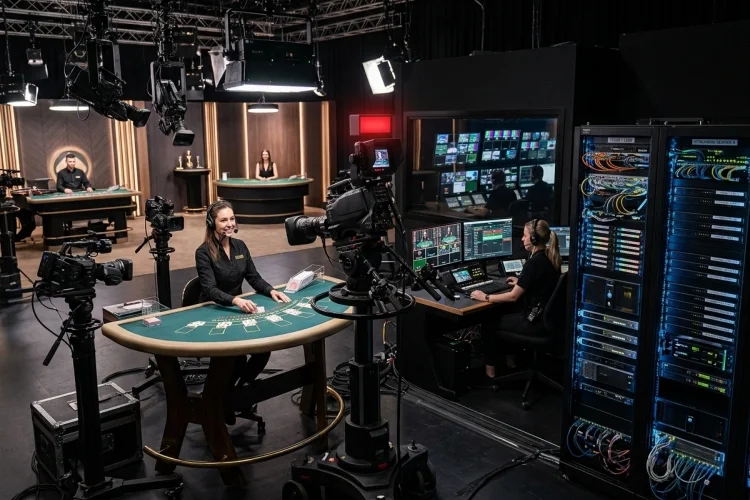
Most live dealer games are broadcast from purpose-built studios that operate like a combination of a casino floor and television production facility. Each table has approved gaming equipment, professional lighting, microphones, cameras, and a workstation used to manage the round.

Studios may contain standard shared tables or dedicated environments created for one operator. Dedicated rooms can use customized interiors, branded furniture, localized dealers, and digital backgrounds. Evolution states that its dedicated setups can include physical sets, three-dimensional environments, chroma-key backgrounds, and multilingual teams.

Access to operational areas is normally restricted. Dealers, supervisors, technicians, security personnel, and production staff have separate responsibilities.

Cameras Capture the Physical Game

Multiple cameras allow the player to see the dealer, betting area, cards, wheel, or dice from appropriate angles. A roulette production may switch from a wide view of the table to a close-up of the ball as it approaches the numbered pockets.

Evolution describes dedicated roulette setups using three or more high-definition cameras, with configurable angles, cuts, and sequences. Some specialized baccarat products use many additional cameras to show the handling and revealing of cards.

The video director or automated production system selects the most useful view without interrupting the physical game. Audio is captured separately and synchronized with the picture.

The Game Interface Connects Players to the Table

The video sits behind a digital user interface containing betting controls, balances, timers, histories, and game information. Players do not send physical chips to the studio. Instead, the interface transmits electronic wagering instructions to the casino platform.

During roulette, for example, the player selects a chip value and places it on a digital representation of the table. In blackjack, the interface also sends decisions such as hit, stand, double, or split.

Evolution explains that live casino software lets users place bets, make game decisions, and communicate through an interface while watching the studio stream on a phone or computer.

How Bets Reach the Game Server

When a player confirms a wager, the platform checks the account balance, table limits, betting status, and transaction time. An accepted bet is recorded before the betting window closes.

The server must prevent access to the result before wagers are finalized. GLI-19 also states that live systems should record gaming activity and results through simulcast control servers while providing players with real-time audiovisual access.

After “no more bets” is announced, the interface disables further wagering. The physical action can then determine the result without accepting late entries.

How the Physical Result Becomes Digital Data

Once the dealer completes the round, the outcome must be entered into the gaming platform. The exact method depends on the game and equipment.

Cards may be registered as they are dealt through approved reading technology or confirmed through the dealer’s game-management workstation.

Roulette equipment can communicate the winning number to the control system, while supervisors may verify unusual or disputed outcomes.

The result is recorded before being posted to the player interface. GLI standards also require mechanisms for authorized personnel to void a result when a genuine game irregularity makes that necessary.

Video Compression and Low-Latency Delivery

Raw studio video is too large to send directly to thousands of devices. It is encoded and compressed before being distributed through streaming infrastructure.

The system may provide different video-quality levels for different devices and connection speeds. A desktop user with fast broadband may receive a sharper feed than someone using a weak mobile network.

Low latency is important because the interface and studio action must appear closely synchronized. Even so, a short delay may exist between the physical table and the player’s screen.

Technical standards therefore require operators to disclose minimum connection requirements and provide equivalent-quality feeds when communications begin or reconnect.

Payouts and Account Updates

After the result is verified, the game engine compares it with every accepted wager. Winning bets are calculated according to the published paytable, while losing stakes remain deducted.

Account balances and betting histories are then updated. This settlement may happen quickly, although the next round should not begin until the previous game has been properly recorded.

If a player’s connection fails after the bet has been accepted and the person can no longer influence the outcome, UK Gambling Commission guidance says that the result should normally stand.

When an interruption occurs before an outcome is generated in a single-stage game, the deducted stake should generally be returned.

Surveillance and Quality Control

Live casino studios use surveillance and recording systems to monitor game procedures, equipment, dealer activity, and technical events. GLI-19 calls for continuous recordings detailed enough to reconstruct games, confirm whether procedures were followed, and review complaints.

Licensed operations may also be independently audited. The UK Gambling Commission requires live dealer operations under its authority to be fair and independently auditable.

Recordings and transaction logs help distinguish a streaming problem from an incorrect result or unaccepted wager.

Live casino streaming combines physical gaming equipment with television production, interactive software, secure servers, transaction records, and real-time account settlement.

Cameras and microphones capture the table, while the gaming interface sends player decisions and accepted bets to the platform. The result must be verified and stored before payouts are calculated.

Surveillance recordings and technical logs provide evidence when a disconnection or disputed round occurs. Before joining a live table, verify the operator’s licence, read its interruption policy, and confirm the betting limits.

Use a stable connection, avoid last-second wagers, and set clear spending and session limits before the broadcast begins.

Live Casino

The Advantages and Limitations of Live Dealer Games Explained

Live dealer casino games sit between traditional casino tables and fully digital online games. Instead of watching computer-generated cards or wheels, players connect to a video stream showing a real presenter, physical gaming equipment, and a studio designed to resemble a casino floor.

This format has become popular because it brings human interaction into online blackjack, roulette, baccarat, game shows, and other table games.

Professional studios may use several high-definition cameras, real-time betting interfaces, chat functions, statistics, and transaction histories to create an immersive experience on desktop and mobile devices.

However, realism introduces practical limitations. Live rounds depend on human dealing, studio schedules, available seats, betting windows, streaming quality, and the player’s internet connection. Some tables may also carry minimum wagers that are unsuitable for smaller budgets.

Understanding the advantages and limitations of live dealer games helps players decide whether the format matches their preferred pace, device, budget, and expectations.

What Are Live Dealer Games?

A live dealer game is conducted by a real dealer or presenter and streamed from a casino floor or specialist studio. Players use an on-screen interface to place digital wagers while watching the physical cards, wheel, dice, or other equipment through a video feed.

The system connects studio activity with the online betting platform. GLI technical guidance says live services should provide real-time audiovisual access and identify information such as the game, table, time, and location.

It also recommends recording live play so disputed rounds can be reconstructed and reviewed.

Advantage: A More Authentic Casino Atmosphere

The strongest appeal is the sense of participating in a real table game. Players can see cards being dealt, roulette balls spinning, and presenters managing each round instead of relying entirely on digital animation.

Live studios often use professional lighting, themed backgrounds, multiple cameras, and trained hosts. Pragmatic Play describes its live platform as using professional dealers, advanced broadcasting technology, and several 4K-quality camera views.

This atmosphere can make familiar games easier to recognize for people accustomed to physical casinos. It also adds natural pauses and human presentation that automated games may not provide.

Advantage: Interaction With Dealers and Other Players

Many live games include chat tools that allow users to communicate with the presenter or view messages from other participants. ONE Blackjack, for example, offers chat with the host, other players, and live support alongside detailed betting history.

The interaction is limited compared with sitting at a physical table, but it can reduce the solitary feeling associated with standard online gaming. Dealers may welcome participants, explain procedures, or announce results as the round develops.

Dedicated studios can also provide localized presenters, languages, uniforms, and environments. Evolution states that its dedicated tables may use culturally and linguistically relevant dealers and personalized interaction.

Advantage: Visible Procedures and Audit Controls

Watching a real table can make the dealing procedure more visible. Players may observe shuffling, card distribution, wheel movement, and the dealer’s actions through several camera angles.

Visibility alone does not prove that an operator is trustworthy. The stronger protection comes from licensing, documented procedures, supervision, and independent auditing.

The UK Gambling Commission requires regulated live dealer operations to be fair and independently auditable. Its guidance also calls for trained croupiers, commercial-quality equipment, surveillance, secure access, and game logs that can be analyzed for irregularities.

Advantage: Convenient Access to Table Games

Live tables allow users to experience dealer-led blackjack, baccarat, roulette, and game-show formats without travelling to a casino venue. Some providers broadcast selected tables around the clock and make them accessible through desktop and mobile browsers.

Online interfaces may also provide features that are difficult to reproduce at a physical table. Examples include saved bets, detailed statistics, zoom functions, betting histories, and automated decision tools.

Availability still differs by jurisdiction. Online casino regulation may operate nationally, regionally, or through market-specific licences, so a game offered in one country may be unavailable in another.

Limitation: Slower and Less Flexible Gameplay

Live rounds must allow time for bets to be placed, equipment to be handled, and results to be confirmed. This generally makes the experience slower than fully automated casino software.

Even products marketed as speed games retain structured rounds. Pragmatic Play states that its Speed Roulette averages approximately 25 seconds per round, while its accelerated blackjack and baccarat products shorten dealing and decision times.

Some players appreciate this pace because it encourages more deliberate decisions. Others may find the waiting periods inconvenient, especially when sharing a blackjack table with participants who use their full decision time.

Limitation: Dependence on Internet and Streaming Quality

Live games require a continuous flow of video, audio, betting data, and result information. Weak Wi-Fi, limited mobile data, device performance, or network congestion can cause freezing, delayed pictures, or interrupted wagers.

GLI guidance states that live providers should establish and disclose a minimum connection requirement. It also recommends procedures for reconnecting interrupted feeds and managing disruptions to video, audio, or data streams.

A delayed image does not necessarily mean the actual game has stopped. The studio may continue operating while the player’s device struggles to display the stream, making a reliable connection essential.

Limitation: Table Limits, Seats, and Fixed Betting Windows

Every table has minimum and maximum wagers. These boundaries may be unsuitable for players who want very small stakes or unusually high limits.

Blackjack tables may also have a limited number of seats. Some scalable versions allow many users to make separate decisions from one position, while VIP products may intentionally restrict participation to one or only a few players.

Betting windows can be short. Once the countdown closes, late wagers are rejected even when a player intended to repeat a previous bet. Reviewing the interface before the first paid round reduces hurried mistakes.

Limitation: Realism Does Not Remove Gambling Risk

A visible dealer and professional studio can make a game feel more trustworthy, but they do not remove the house advantage or guarantee positive results. Physical cards and wheels still produce uncertain outcomes.

The social atmosphere may also encourage longer sessions if players stop noticing elapsed time. Reality-check tools can display session duration and give users an opportunity to exit or review their account history.

WHO warns that gambling can affect finances, health, relationships, and household spending. A fixed entertainment limit remains necessary regardless of how authentic the game appears.

Live dealer games offer realistic presentation, human interaction, visible procedures, and convenient access to familiar casino tables.

They can feel more engaging than automated games and may include useful features such as statistics, chat, multiple cameras, and transaction histories.

Their limitations include slower rounds, connection requirements, fixed betting windows, table limits, seat availability, and continued exposure to gambling losses.

Before joining a table, verify the operator’s licence, test the stream, read the rules, and confirm the minimum wager. Activate a time reminder and establish a strict entertainment budget before betting.

Choose live play only when its pace, technical requirements, and financial limits suit your circumstances.

Online Slots

Fixed Paylines vs. Adjustable Paylines in Online Slots Explained

Online slots can look similar while using very different systems for calculating wins. Two games may both have five reels and three rows, yet one requires every payline to remain active while the other lets players choose how many winning paths they want to cover.

Understanding fixed paylines vs. adjustable paylines in online slots helps explain why the minimum spin cost differs between games.

It also prevents a common mistake: assuming that matching symbols will always produce a prize simply because they appear somewhere on the reels.

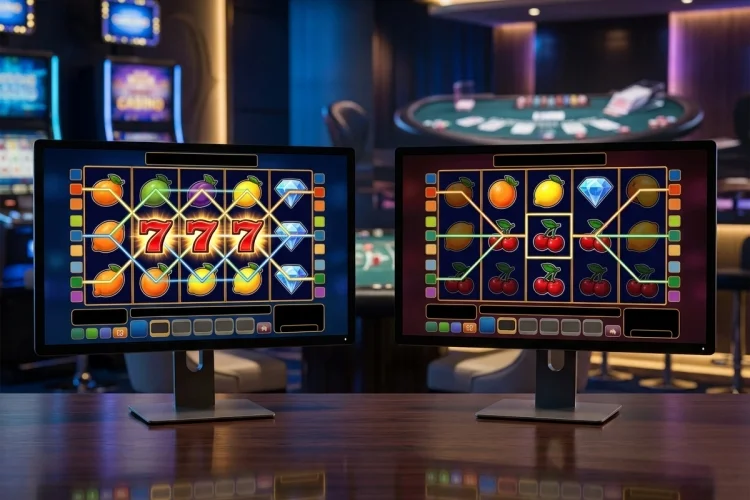
A payline is a predefined route across the slot grid. It may run horizontally, diagonally, or through a more complex pattern. A winning combination normally has to appear on an active line and follow the direction stated in the game rules.

Neither payline format guarantees better results. Fixed lines offer a straightforward betting structure, while adjustable lines provide more control over stake distribution.

The most appropriate option depends on the paytable, total wager, bonus conditions, and personal entertainment budget.

What Are Paylines in Online Slots?

A payline identifies the reel positions that can form an eligible winning combination. Traditional slots often use a single horizontal line, while video slots may contain 10, 20, 30, or many more paths.

A symbol pattern that appears outside an active line usually does not pay, unless the game uses scatter symbols, clusters, or a ways-to-win mechanic. Players should therefore check the information screen before assuming that visually connected icons create a prize.

GLI standards for interactive games state that multi-line titles should provide a summary of the available paylines. Individual lines being played should also be clearly indicated to the user.

How Fixed Paylines Work

Fixed paylines are always active during every paid spin. Players can normally change the total stake, denomination, or bet level, but they cannot switch individual winning paths off.

For example, a slot with 20 fixed paylines may require every spin to cover all 20 lines. If the minimum total wager is $0.20, the game automatically distributes that amount according to its internal betting structure.

This format makes the interface simple. Players do not need to decide which lines to activate, and every listed path remains eligible to produce a win.

However, fixed lines can also create a higher minimum spin cost than a comparable adjustable-line game. The actual minimum depends on the developer’s settings rather than the number of lines alone.

How Adjustable Paylines Work

Adjustable paylines allow players to select how many winning paths are active. A 20-line slot might permit choices such as one, five, 10, 15, or all 20 lines.

In a conventional per-line betting model, the total wager can be calculated as:

Active paylines × stake per line = total spin cost

If 10 lines are active at $0.02 per line, the total bet is $0.20. Selecting all 20 lines at the same line stake increases the cost to $0.40.

The trade-off is that inactive paylines cannot award ordinary line prizes. A perfect combination may appear on the screen but produce no payment when it lands on a path that was not selected.

Comparing Winning Coverage

Fixed-payline slots automatically provide complete coverage of every available line. This does not mean that they produce more profitable sessions, but it does mean that every predefined path is eligible on every spin.

Adjustable-line games offer variable coverage. Activating fewer paths reduces the number of patterns that can qualify, while selecting more lines increases both coverage and usually the total wager.

Suppose a game contains 20 possible paylines, but only five are active. The player is covering one quarter of the listed paths. Wins can still occur, but ordinary combinations on the other 15 lines will not be counted.

The exact relationship depends on the game design. Some slots use fixed total-bet settings rather than a simple line-bet formula, which is why the paytable must be read carefully.

Does the Number of Lines Change RTP?

Return to player, or RTP, represents the theoretical proportion of total stakes a game is designed to return as prizes over a very large number of plays. It is not a guaranteed result for one session.

Reducing active lines does not automatically improve RTP. In many traditional adjustable-line games, each active line follows the same mathematical model, so using fewer lines mainly changes total exposure and winning coverage.

Other games may use different return settings, bonus eligibility, or jackpot conditions at particular bet levels. A player should not assume that every line configuration provides the same theoretical return unless the rules confirm it.

The UK Gambling Commission explains that designed RTP differs from actual short-term performance, which can fluctuate because of normal game volatility.

Fixed and Adjustable Lines Versus Ways to Win

Not every modern slot uses paylines. Ways-to-win games may award symbols that appear on adjacent reels without requiring them to follow a drawn path.

Cluster-pay slots use another system. They generally reward connected groups of matching symbols rather than left-to-right line combinations.

These mechanics should not be confused with fixed paylines. A game advertising hundreds or thousands of winning ways may have no selectable lines at all.

The official rules should explain how wins are formed before a wager is placed. Ontario standards require paytable awards, game rules, feature information, and relevant selection details to be available before the player commits to a bet.

Which Format Offers More Control?

Adjustable paylines provide more direct control over the number of active winning routes. They may suit players who want to reduce the cost of each spin while accepting narrower coverage.

Fixed paylines provide less configuration but create a clearer experience. Players know that every listed line is active without repeatedly checking the line-selection setting.

Neither option changes the basic nature of slot games. Outcomes should be generated randomly, and previous wins or losses must not influence the next result.

UK technical guidance requires random-number output to be demonstrably random and prohibits adaptive behavior that changes results according to prior play.

Fixed paylines remain active on every spin, while adjustable paylines allow players to choose how many predefined winning paths they cover.

Fixed systems are simple and prevent missed wins on inactive lines. Adjustable systems provide greater control over stake distribution, but reducing coverage also means more displayed combinations may be ineligible.

Before playing, open the paytable and confirm the number of lines, total spin cost, winning direction, and bonus requirements. Do not assume that more paylines create better RTP or that fewer lines improve the odds.

Select a stake that fits a predetermined entertainment limit, and avoid increasing line coverage simply to recover previous losses.

Online Slots

How Slot Paytables Work and Why Every Player Should Read Them

Modern slot games often attract attention through colorful graphics, animations, jackpots, and bonus rounds. However, the most useful information is usually hidden behind a small button labeled “Paytable,” “Info,” “Help,” or “Game Rules.”

Learning how slot paytables work helps players understand what must happen before a prize is awarded.

A paytable explains the value of each symbol, the required number of matching icons, eligible paylines or winning patterns, and the rules governing wilds, scatters, free spins, multipliers, and jackpots.

This information is important because two visually similar games may use completely different mechanics. One slot may pay only for symbols appearing from the leftmost reel, while another may award combinations from either direction.

Some games use fixed paylines, while others count matching symbols on adjacent reels or anywhere within a cluster.

A paytable does not predict the next result or guarantee a winning session. Instead, it provides the instructions needed to understand what you are buying with each spin.

What Is a Slot Paytable?

A slot paytable is the game’s official guide to winning combinations and prizes. It normally shows the symbols used in the game and the amount awarded when a required number of those icons appears in an eligible pattern.

Gaming Laboratories International’s technical standards identify important reel-game information such as the number of reels, number of lines, maximum credits per line, winning combinations, and payment amounts.

Regulators may also require this information to be available before a wager is placed. Ontario’s Alcohol and Gaming Commission states that paytable awards, game rules, feature information, and automatic-selection rules must be accessible before the player commits to a bet.

How Symbol Payouts Are Displayed

Most paytables organize symbols from the highest-paying icon to the lowest-paying one. A premium symbol might award 100 credits for five matches, while a lower-value symbol may pay only 10 credits for the same number.

The listed figure is often shown in credits rather than dollars, pounds, or another currency. To calculate the cash value, the player must understand the selected denomination and total wager.

For example, if five matching symbols award 50 credits and one credit is worth $0.10, the prize would equal $5.00. This hypothetical result applies only when the symbols appear according to the game’s stated winning pattern.

Understanding Paylines and Winning Ways

Traditional video slots use paylines that pass through specific reel positions. A game may have one, 10, 20, 30, or more lines, and a winning combination must land on an active line.

Some games use much larger configurations. One IGT slot description, for example, refers to a game with 120 paylines and encourages players to cover all available lines.

Other slots use “ways to win,” clusters, or scatter-pay mechanics instead of conventional lines. The paytable should explain whether matches must start on reel one, appear on consecutive reels, or form a connected group.

How Bet Size Affects the Paytable

In many slots, increasing the stake raises the monetary value of each listed prize without changing the required symbol combination. A five-symbol win may pay 20 times the bet whether the player wagers $0.20 or $2.00, but the cash amount changes.

Other games may connect bet settings to active paylines, coin values, bonus eligibility, or jackpot qualification. These conditions are not universal, so they should never be assumed.

Check whether the displayed prize represents the total bet, the line bet, or a fixed number of credits. Misreading this detail can make a modest payout appear much larger than it actually is.

Wilds, Scatters, and Bonus Symbols

Wild symbols normally substitute for selected regular icons, although they may exclude scatters, bonus symbols, or jackpots. Some wilds also carry multipliers, expand across reels, move between positions, or remain active during several spins.

Scatters frequently award prizes without following a standard payline. They may also trigger free spins when a specified number appears anywhere in view.

Pragmatic Play’s Sugar Rush 1000, for example, states that three or more scatters trigger at least 10 free games. Additional scatters during the feature can award more spins, while multipliers remain on marked positions during the round.

How RTP Relates to the Paytable

Return to player, or RTP, is the theoretical percentage of total stakes a game is designed to return over a very large number of plays. It is not a promise that an individual player will receive the stated percentage during one session.

The UK Gambling Commission explains that RTP is a long-term average and that actual short-term results vary because of normal game volatility. It also notes that previous wins and losses do not change the odds of the next result on a random machine.

A paytable contributes to the game’s mathematical return, but it does not normally reveal the probability of every symbol combination. A large top prize may therefore be extremely rare.

Why You Should Read the Paytable First

Reading the paytable prevents incorrect assumptions about how wins are formed. It can reveal that a wild substitutes only in certain situations, that scatter prizes are multiplied by the total stake, or that a jackpot requires a specific bet level.

It also helps players compare games more intelligently. A slot with hundreds of paylines is not automatically more generous than a one-line machine, and a large maximum prize does not explain how frequently smaller wins occur.

Most importantly, the information supports better spending decisions. When the mechanics seem unclear or the required stake is uncomfortable, the safest choice is not to play.

Slot paytables explain the symbols, winning patterns, prize values, paylines, bonus triggers, wild behavior, and special conditions behind a game. Reading them is the simplest way to understand what each spin can and cannot produce.

Before wagering, check how prizes are calculated, whether matches must appear from a particular reel, and whether changing the bet affects paylines or jackpot access.

Review the RTP where it is displayed, but remember that it represents long-term theoretical performance rather than a personal guarantee.

Open the paytable before your next spin, set a fixed entertainment limit, and avoid any game whose rules or potential costs are not completely clear.

Responsible Gambling

How to Set a Realistic Gambling Budget Step by Step

Gambling may be enjoyable when it is treated as an optional entertainment expense. However, it can become financially harmful when money intended for rent, food, debt payments, savings, or family needs is used to continue playing.

The World Health Organization notes that gambling can create financial distress and divert household spending away from essential goods and services.

Learning how to set a realistic gambling budget is therefore not about finding the largest amount you can afford to deposit. It means choosing a limit that will not damage your financial stability if the entire amount is lost.

There is no universal safe gambling allowance that works for every person. Income, living costs, debt, savings goals, and family responsibilities differ significantly.

A realistic limit must be based on your actual disposable money after every important obligation has been covered. It should also include clear session and time boundaries so that one emotional decision cannot quietly expand the original budget.

Protect Essential Expenses First

Begin with the expenses that must be paid regardless of whether you gamble. These normally include housing, utilities, groceries, transportation, health care, insurance, education, childcare, and minimum debt payments.

Savings should also be treated as a planned commitment rather than whatever remains after entertainment. Include emergency savings, retirement contributions, and money reserved for upcoming expenses.

GamCare recommends identifying priority expenses and tracking spending when trying to protect finances from gambling-related harm. It also warns that gambling should not be viewed as a way to make money or solve financial difficulties.

Calculate Your Real Disposable Income

Disposable gambling money is not the same as the balance currently visible in your bank account. It is the amount remaining after essential expenses, financial goals, and other normal leisure activities have been funded.

A simple calculation is:

Monthly income − essential expenses − debt payments − savings − other planned spending = remaining discretionary income

Suppose someone receives $2,500 each month. Essential bills cost $1,750, debt payments are $200, savings are $250, and other planned leisure expenses total $200. Only $100 remains unallocated.

That does not automatically mean the full $100 should become a gambling budget. The person may choose a much smaller amount or decide that no gambling allowance is appropriate that month.

Choose a Monthly Loss Limit

A gambling budget should be treated as a maximum loss allowance, not as an amount that must be spent. This approach assumes that every wager could be lost.

For example, a monthly limit of $40 means the player is prepared to finish the month with $40 less and still pay every bill comfortably. Winnings should not be used to justify increasing this limit.

GambleAware recommends deciding on a daily, weekly, or monthly spending limit before gambling begins. It also suggests using account limits, separating the funds, writing the amount down, or telling someone trustworthy about the boundary.

Divide the Budget Into Smaller Sessions

A monthly limit can disappear quickly if it is available all at once. Dividing it into smaller session allowances provides additional control.

A practical example

A $40 monthly budget could be divided into four weekly allowances of $10. Alternatively, it could fund two planned sessions of $20 each.

Once a session allowance is gone, the session ends. Money cannot be borrowed from next week, transferred from savings, or recovered by making larger bets.

A time limit should accompany the financial boundary. The UK Gambling Commission recommends using reality checks and time trackers to monitor how long a person spends gambling.

Separate Gambling Money From Other Funds

Keeping gambling funds separate makes the limit easier to see. A dedicated prepaid balance, low-value entertainment account, or fixed cash amount can create a clear boundary.

Avoid linking multiple cards, credit accounts, overdrafts, or easy-access savings to a gambling account. Greater access to money can make an impulsive second deposit feel less significant than it actually is.

Removing stored payment information also adds a pause before another transaction. That brief delay can provide enough time to reconsider whether the deposit fits the original budget.

Track Net Spending, Not Individual Wins

Players sometimes remember withdrawals and winning sessions more clearly than deposits and losses. This can create an inaccurate belief that gambling costs less than it does.

Calculate net gambling expenditure using:

Total deposits and cash spending − total withdrawals = net amount spent

Review activity across every casino, sportsbook, lottery account, and physical venue. The UK Gambling Commission states that account histories can show when someone gambled, how much was spent, and which products were used, making it easier to identify increasing activity.

Do not count an unsettled bet, bonus balance, or temporary in-game win as income. Money has not returned to your personal finances until it has been withdrawn.

Never Increase the Budget to Chase Losses

A losing session does not create a financial obligation to recover the money. Increasing the budget after a loss changes an entertainment expense into an attempt to repair previous gambling results.

GambleAware warns that trying to win back losses often leads to larger losses. Once the predetermined limit is reached, the safer response is to stop.

The next game does not know how much you previously lost. Random outcomes do not become more favorable because your budget has been exhausted.

Review the Limit Every Month

Your gambling allowance should decrease when income falls, expenses increase, or a new financial goal becomes more important. It should become zero when essential bills are overdue, debt is growing, or emergency savings are unavailable.

Review both money and behavior. Repeatedly breaking limits, hiding transactions, borrowing funds, or feeling unable to stop may indicate that budgeting alone is no longer sufficient.

In that situation, consider bank payment blocks, a time-out, blocking software, or self-exclusion. Self-exclusion is intended for people who recognize that their gambling is harmful and want support to stop.

A realistic gambling budget starts only after essential expenses, debt obligations, savings, and ordinary household needs are protected.

Calculate genuine discretionary income, select a maximum loss limit, divide it into smaller sessions, and assume that the entire allowance may be lost.

Keep the funds separate and review total deposits against withdrawals rather than focusing on memorable wins. Never increase the limit to chase losses or use credit to continue playing.

Review your budget before every new month and reduce it whenever your financial circumstances change. Start by examining your latest bank and gambling-account statements today.

When the figures no longer feel comfortable or limits repeatedly fail, stop gambling and seek qualified support.

Responsible Gambling

How to Gamble Responsibly and Stay in Control

Gambling can be an enjoyable form of entertainment when it remains affordable, occasional, and easy to stop. Problems may begin when betting becomes a way to earn money, escape stress, recover previous losses, or change an uncomfortable mood.

Learning how to gamble responsibly and stay in control means deciding your boundaries before a game begins. Clear limits are usually more effective than relying on willpower after excitement, disappointment, or frustration has already influenced your judgment.

Responsible play does not make gambling risk-free. Casino games and betting products are designed around uncertain outcomes, and no strategy can guarantee a profit.

The World Health Organization notes that gambling-related harm can affect finances, relationships, health, employment, and family life.

The objective is therefore not to discover a perfect winning method. It is to protect your money, time, relationships, and well-being while recognizing when taking a longer break – or stopping completely – is the safer choice.

Treat Gambling as Entertainment, Not Income

A healthy starting point is to view gambling in the same way as paying for a film, meal, or sporting event. The money spent buys an experience and may not return.

Do not include potential winnings in your household budget or depend on gambling to cover bills. Even games involving skill contain uncertainty, while casino games normally have a built-in mathematical advantage.

When gambling begins to feel like a financial solution, the pressure to continue increases. That pressure can make it harder to accept losses and leave the game.

Set a Fixed Money Limit First

Choose an affordable amount before opening a gambling account or entering a venue. It should come only from disposable entertainment money left after housing, food, transport, savings, debt payments, and other essential commitments.

Think of this amount as the maximum cost of the session. Once it has been spent, stop instead of transferring additional money from another account.

Many platforms provide deposit, spending, or loss-control tools. The UK Gambling Commission identifies limit setting as one of several tools that can help customers manage gambling activity.

Create a Clear Time Boundary

Financial control is only one part of responsible gambling. Long sessions can interfere with sleep, work, relationships, exercise, and ordinary responsibilities even when the amount spent appears manageable.

Decide when the session will begin and end. A timer or calendar reminder can prevent a short activity from quietly becoming several hours.

Reality-check notifications show how long a gambling session has lasted and require the player to acknowledge the message. These alerts are designed to make elapsed time more visible during online play.

Never Chase Previous Losses

Chasing means continuing or increasing bets in an attempt to recover money already lost. It often turns a disappointing session into a much more expensive one.

A loss does not make the next wager more likely to win. Random games do not compensate players because they have experienced an unlucky sequence.

GambleAware advises stopping when the predetermined limit has been reached because attempts to win back losses can produce even larger losses and wider personal harm. Treat every completed wager as final rather than as a debt the next game must repay.

Avoid Gambling When Judgment Is Weakened

Strong emotions can reduce the quality of financial decisions. Avoid gambling while angry, lonely, stressed, depressed, exhausted, or desperate for a distraction.

Alcohol and other substances may also weaken self-control. When your judgment is impaired, it becomes easier to increase stakes, ignore limits, or misunderstand the amount already spent.

GamCare advises setting money and time boundaries and warns against gambling when angry or upset. A useful personal rule is to gamble only when calm, rested, and able to stop without resistance.

Use Safer Gambling Tools Early

Protective tools are most useful before serious difficulties develop. Depending on the operator and jurisdiction, these may include deposit limits, activity statements, reality checks, cooling-off periods, bank transaction blocks, and blocking software.

A time-out temporarily prevents access and creates distance from impulsive decisions. The UK Gambling Commission explains that time-outs can provide a break, help users monitor spending, and support clearer thinking.

Some banks also allow customers to block gambling payments. Device-level software can restrict access to gambling websites and applications, adding another barrier between an urge and a transaction.

Recognize Signs That Control Is Slipping

Warning signs may include spending more than intended, hiding activity, borrowing money, repeatedly chasing losses, neglecting responsibilities, or feeling restless when trying to stop.

The National Council on Problem Gambling defines problem gambling as behavior that harms the individual or family and disrupts daily life or employment. It also recognizes gambling disorder as a mental health diagnosis.

The NHS notes that gambling can damage finances, physical and mental health, and relationships. If these effects are appearing, seeking support early is more important than trying to prove you can regain control alone.

Knowing how to gamble responsibly and stay in control begins with accepting that gambling is paid entertainment, not a reliable income source.

Set firm money and time limits, avoid chasing losses, keep essential funds separate, and never gamble when emotions or substances are affecting your judgment.

Use account limits and reality checks before they feel necessary, not only after a problem develops. Review your activity honestly and pay attention to concerns raised by people you trust.

When stopping becomes difficult or gambling starts affecting your finances, health, or relationships, take a break and contact a qualified support service. Protecting your well-being is always more valuable than continuing another game.