
How Live Casino Streaming Works Behind the Scenes
A live casino table may look simple from the player’s screen. A dealer handles physical cards or spins a roulette wheel, bets appear on a digital layout, and the result is confirmed within seconds.
Behind that experience is a coordinated system involving cameras, microphones, game-management software, streaming servers, surveillance, and transaction processing.
Understanding how live casino streaming works behind the scenes reveals that the video feed is only one part of the operation.
The platform must also receive bets, close the wagering window at the correct moment, record the physical result, calculate payouts, and update many player accounts simultaneously.
Unlike a fully automated casino game, a live table combines real equipment and human procedures with digital interfaces.
Industry standards describe live games as real-time audiovisual experiences in which a platform receives player instructions and records gaming activity through control servers.
The entire process must remain synchronized so that no one can place a wager after the outcome becomes known.
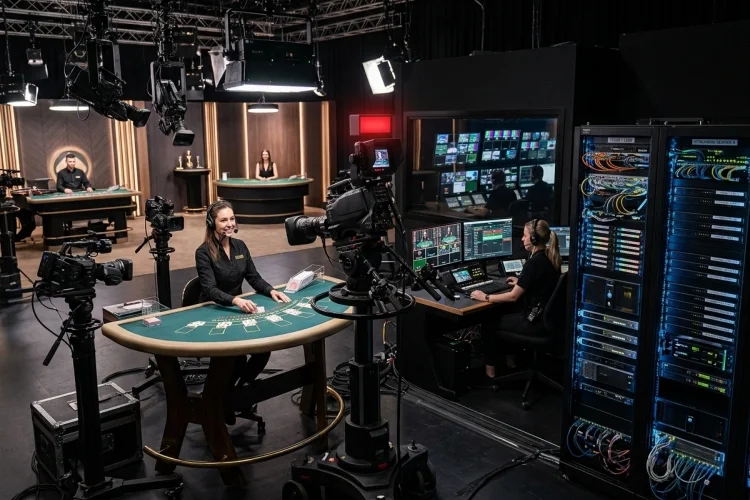
The Live Casino Studio
Most live dealer games are broadcast from purpose-built studios that operate like a combination of a casino floor and television production facility. Each table has approved gaming equipment, professional lighting, microphones, cameras, and a workstation used to manage the round.
Studios may contain standard shared tables or dedicated environments created for one operator. Dedicated rooms can use customized interiors, branded furniture, localized dealers, and digital backgrounds. Evolution states that its dedicated setups can include physical sets, three-dimensional environments, chroma-key backgrounds, and multilingual teams.
Access to operational areas is normally restricted. Dealers, supervisors, technicians, security personnel, and production staff have separate responsibilities.
Cameras Capture the Physical Game
Multiple cameras allow the player to see the dealer, betting area, cards, wheel, or dice from appropriate angles. A roulette production may switch from a wide view of the table to a close-up of the ball as it approaches the numbered pockets.
Evolution describes dedicated roulette setups using three or more high-definition cameras, with configurable angles, cuts, and sequences. Some specialized baccarat products use many additional cameras to show the handling and revealing of cards.
The video director or automated production system selects the most useful view without interrupting the physical game. Audio is captured separately and synchronized with the picture.
The Game Interface Connects Players to the Table
The video sits behind a digital user interface containing betting controls, balances, timers, histories, and game information. Players do not send physical chips to the studio. Instead, the interface transmits electronic wagering instructions to the casino platform.
During roulette, for example, the player selects a chip value and places it on a digital representation of the table. In blackjack, the interface also sends decisions such as hit, stand, double, or split.
Evolution explains that live casino software lets users place bets, make game decisions, and communicate through an interface while watching the studio stream on a phone or computer.
How Bets Reach the Game Server
When a player confirms a wager, the platform checks the account balance, table limits, betting status, and transaction time. An accepted bet is recorded before the betting window closes.
The server must prevent access to the result before wagers are finalized. GLI-19 also states that live systems should record gaming activity and results through simulcast control servers while providing players with real-time audiovisual access.
After “no more bets” is announced, the interface disables further wagering. The physical action can then determine the result without accepting late entries.
How the Physical Result Becomes Digital Data
Once the dealer completes the round, the outcome must be entered into the gaming platform. The exact method depends on the game and equipment.
Cards may be registered as they are dealt through approved reading technology or confirmed through the dealer’s game-management workstation.
Roulette equipment can communicate the winning number to the control system, while supervisors may verify unusual or disputed outcomes.
The result is recorded before being posted to the player interface. GLI standards also require mechanisms for authorized personnel to void a result when a genuine game irregularity makes that necessary.
Video Compression and Low-Latency Delivery
Raw studio video is too large to send directly to thousands of devices. It is encoded and compressed before being distributed through streaming infrastructure.
The system may provide different video-quality levels for different devices and connection speeds. A desktop user with fast broadband may receive a sharper feed than someone using a weak mobile network.
Low latency is important because the interface and studio action must appear closely synchronized. Even so, a short delay may exist between the physical table and the player’s screen.
Technical standards therefore require operators to disclose minimum connection requirements and provide equivalent-quality feeds when communications begin or reconnect.
Payouts and Account Updates
After the result is verified, the game engine compares it with every accepted wager. Winning bets are calculated according to the published paytable, while losing stakes remain deducted.
Account balances and betting histories are then updated. This settlement may happen quickly, although the next round should not begin until the previous game has been properly recorded.
If a player’s connection fails after the bet has been accepted and the person can no longer influence the outcome, UK Gambling Commission guidance says that the result should normally stand.
When an interruption occurs before an outcome is generated in a single-stage game, the deducted stake should generally be returned.
Surveillance and Quality Control
Live casino studios use surveillance and recording systems to monitor game procedures, equipment, dealer activity, and technical events. GLI-19 calls for continuous recordings detailed enough to reconstruct games, confirm whether procedures were followed, and review complaints.
Licensed operations may also be independently audited. The UK Gambling Commission requires live dealer operations under its authority to be fair and independently auditable.
Recordings and transaction logs help distinguish a streaming problem from an incorrect result or unaccepted wager.
Live casino streaming combines physical gaming equipment with television production, interactive software, secure servers, transaction records, and real-time account settlement.
Cameras and microphones capture the table, while the gaming interface sends player decisions and accepted bets to the platform. The result must be verified and stored before payouts are calculated.
Surveillance recordings and technical logs provide evidence when a disconnection or disputed round occurs. Before joining a live table, verify the operator’s licence, read its interruption policy, and confirm the betting limits.
Use a stable connection, avoid last-second wagers, and set clear spending and session limits before the broadcast begins.