
Pai Gow Poker Rules and Basic Gameplay: A Beginner’s Guide
Pai Gow Poker can look confusing the first time seven cards arrive and you are told to turn them into two separate poker hands. Fortunately, the basic idea is much simpler than the table layout makes it seem.
This guide to Pai Gow Poker Rules and Basic Gameplay explains how the cards are dealt, how players divide their hands, how the dealer competes against them, and why pushes happen so frequently.
Once you understand the relationship between the two-card and five-card hands, a typical round becomes surprisingly easy to follow.
What Is Pai Gow Poker?
Pai Gow Poker combines familiar poker hand rankings with an arrangement inspired by the traditional Chinese game of Pai Gow.
The standard casino version normally uses 53 cards: a regular 52-card deck plus one joker. Each player and the banker receives seven cards.
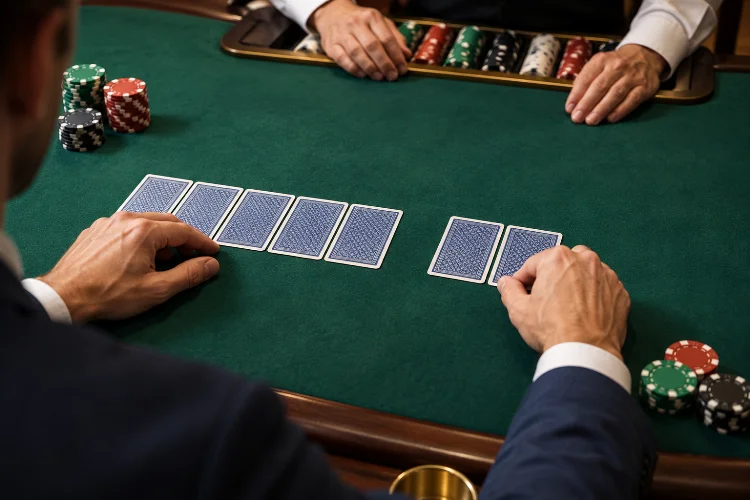
Instead of forming one poker hand, you divide those seven cards into two hands.
The first is a five-card hand, often called the high, back, or bottom hand. The second contains two cards and is commonly called the low, front, or top hand.
Your five-card hand must rank at least as high as the two-card hand. If the hands are arranged incorrectly, the hand can be considered fouled under the applicable table rules.
That balancing decision is the main strategic element of the game.
How a Round Begins
Before cards are dealt, players place their main wagers.
Seven cards are then distributed to each participating position and the banker. The exact dealing procedure can vary by casino.
Bellagio’s published guide, for example, describes using dice to determine which position receives the first packet, while other casinos can use approved electronic randomisation procedures.
Once you receive your cards, you examine all seven and decide how to split them.
The dealer eventually sets the banker’s cards according to a predetermined procedure known as the house way.
Players are therefore making their own setting decision while the dealer follows an established system.
How the Five-Card Hand Works
The five-card portion generally follows standard poker rankings.
That means hands such as a pair, two pair, three of a kind, straight, flush, full house, four of a kind, straight flush, and royal flush are recognised.
The joker adds one unusual element.
In the common Nevada-style version, the joker is semi-wild. It can represent an ace or be used to complete a straight, flush, straight flush, or royal flush.
It is not simply a completely wild card that can become anything in every situation.
Some jurisdictions and individual variants do use different joker rules, so checking the table instructions remains important.
With the conventional semi-wild joker rule, five aces can also become possible because the joker may function as an additional ace.
How the Two-Card Hand Is Ranked
The two-card hand is much simpler.
There are essentially only two basic categories: a pair or two unpaired cards.
A pair beats any non-pair. Among pairs, higher ranks beat lower ranks, so two aces represent the strongest conventional two-card hand.
If neither hand contains a pair, compare the highest cards first.
For example, A-K beats A-Q. If both highest cards match, the second card decides the ranking.
Straights and flushes have no special meaning in a two-card hand. A suited ace and king is still simply ace-king.
This is one of the most usefull concepts for beginners because it prevents them from weakening the five-card hand to create a two-card “flush” that has no additional value.
Your Five-Card Hand Must Be Stronger
You cannot simply place your two strongest cards in front and use whatever remains behind.
The five-card hand must outrank the two-card hand.
Suppose your seven cards include K-K, Q-Q, A, 8, and 3.
You could potentially keep both pairs together in the five-card hand while placing A-8 in front, or split one pair into the two-card hand and keep the other pair behind.
Which arrangement is preferable depends on the complete cards and strategy being used.
However, you could not put K-K in the two-card hand while leaving only Q-Q in the five-card hand because the front hand would outrank the back.
Casinos typically provide a house-way option or dealer assistance for players unfamiliar with setting difficult hands.
How the Player Beats the Banker
After both sides set their cards, the two corresponding hands are compared separately.
Your five-card hand competes against the banker’s five-card hand. Your two-card hand competes against the banker’s two-card hand.
To win the overall main wager, you normally need to win both comparisons.
If you win one and lose the other, the overall bet is a push, meaning neither side wins the main wager.
If the banker wins both comparisons, you lose.
This push mechanism is one reason Pai Gow Poker often feels slower than casino games where practically every round ends with a complete win or loss.
What Happens When the Hands Tie?
An exact tie is often called a copy.
Under traditional Pai Gow Poker rules, copies go to the banker.
Suppose both two-card hands are A-K. The banker wins that comparison.
If your five-card hand beats the banker’s five-card hand, the total result would normally become a push because you won one comparison but the banker took the other.
This banker advantage is an important part of the game’s mathematics.
It is also why a tie is not handled in quite the same way as a standard poker showdown between players.
Winning Bets and the Traditional Commission
In conventional Pai Gow Poker, winning the main wager usually pays even money before commission.
A traditional structure charges a 5% commission on winning player wagers. A $100 winning wager would therefore generate $95 in profit rather than the full $100. Bellagio and Hard Rock both describe this traditional 5% commission structure in their published rules.
However, not every modern table uses that structure.
Commission-free variants exist, but they normally compensate for removing the commission by changing another rule. For example, some versions create an automatic push when the dealer has a particular hand.
Always read the exact rules rather than assuming every Pai Gow table settles wins identically.
What Does “House Way” Mean?
The house way is the predetermined system the casino uses to arrange the dealer’s seven cards.
It prevents the dealer from improvising differently against individual players.
House-way charts can become surprisingly detailed, especially for hands containing two pairs, full houses, four of a kind, or multiple possible straights and flushes.
MGM Grand’s published house-way information, for example, applies different splitting rules depending on the strength of two pairs and the remaining high cards.
Beginners do not need to memorise the entire chart immediately.
Start by understanding simple hands. A single pair will commonly remain in the five-card hand while the strongest remaining cards form the two-card hand.
More complicated arrangements become easier with experiance.
Banking Is Another Unusual Feature
Traditional Pai Gow Poker can allow players to take a turn as the banker.
When a player banks, other wagers can effectively be played against that person’s bank rather than automatically against the casino dealer.
The banker also receives the advantage of winning copy hands.
Not every casino or modern variant offers player banking, and procedures can differ considerably. Wizard of Odds notes that conventional play may rotate the banking opportunity among players, while several newer commission-free versions remove player banking entirely.
For a beginner, it is perfectly reasonable to learn ordinary player-versus-house rounds first.
Banking adds another layer that can be explored later.
Learning Pai Gow Poker Rules and Basic Gameplay mainly comes down to understanding how seven cards become two valid poker hands. Win both comparisons and you win; split them and the round usually pushes; lose both and the wager is lost.
Before playing, check the joker rule, commission structure, house way, and banking conditions at that specific table. Those details can vary between casinos and game versions.