
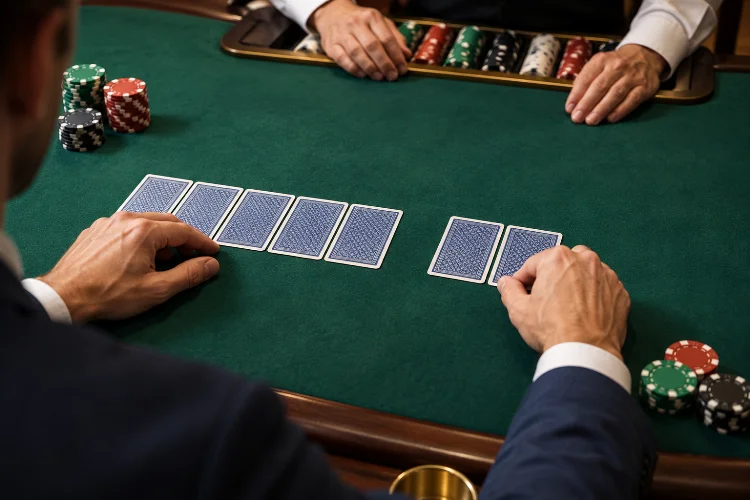
Tag: Table Games

Table Games

Pai Gow Poker Rules and Basic Gameplay: A Beginner’s Guide

Pai Gow Poker can look confusing the first time seven cards arrive and you are told to turn them into two separate poker hands. Fortunately, the basic idea is much simpler than the table layout makes it seem.

This guide to Pai Gow Poker Rules and Basic Gameplay explains how the cards are dealt, how players divide their hands, how the dealer competes against them, and why pushes happen so frequently.

Once you understand the relationship between the two-card and five-card hands, a typical round becomes surprisingly easy to follow.

What Is Pai Gow Poker?

Pai Gow Poker combines familiar poker hand rankings with an arrangement inspired by the traditional Chinese game of Pai Gow.

The standard casino version normally uses 53 cards: a regular 52-card deck plus one joker. Each player and the banker receives seven cards.

Instead of forming one poker hand, you divide those seven cards into two hands.

The first is a five-card hand, often called the high, back, or bottom hand. The second contains two cards and is commonly called the low, front, or top hand.

Your five-card hand must rank at least as high as the two-card hand. If the hands are arranged incorrectly, the hand can be considered fouled under the applicable table rules.

That balancing decision is the main strategic element of the game.

How a Round Begins

Before cards are dealt, players place their main wagers.

Seven cards are then distributed to each participating position and the banker. The exact dealing procedure can vary by casino.

Bellagio’s published guide, for example, describes using dice to determine which position receives the first packet, while other casinos can use approved electronic randomisation procedures.

Once you receive your cards, you examine all seven and decide how to split them.

The dealer eventually sets the banker’s cards according to a predetermined procedure known as the house way.

Players are therefore making their own setting decision while the dealer follows an established system.

How the Five-Card Hand Works

The five-card portion generally follows standard poker rankings.

That means hands such as a pair, two pair, three of a kind, straight, flush, full house, four of a kind, straight flush, and royal flush are recognised.

The joker adds one unusual element.

In the common Nevada-style version, the joker is semi-wild. It can represent an ace or be used to complete a straight, flush, straight flush, or royal flush.

It is not simply a completely wild card that can become anything in every situation.

Some jurisdictions and individual variants do use different joker rules, so checking the table instructions remains important.

With the conventional semi-wild joker rule, five aces can also become possible because the joker may function as an additional ace.

How the Two-Card Hand Is Ranked

The two-card hand is much simpler.

There are essentially only two basic categories: a pair or two unpaired cards.

A pair beats any non-pair. Among pairs, higher ranks beat lower ranks, so two aces represent the strongest conventional two-card hand.

If neither hand contains a pair, compare the highest cards first.

For example, A-K beats A-Q. If both highest cards match, the second card decides the ranking.

Straights and flushes have no special meaning in a two-card hand. A suited ace and king is still simply ace-king.

This is one of the most usefull concepts for beginners because it prevents them from weakening the five-card hand to create a two-card “flush” that has no additional value.

Your Five-Card Hand Must Be Stronger

You cannot simply place your two strongest cards in front and use whatever remains behind.

The five-card hand must outrank the two-card hand.

Suppose your seven cards include K-K, Q-Q, A, 8, and 3.

You could potentially keep both pairs together in the five-card hand while placing A-8 in front, or split one pair into the two-card hand and keep the other pair behind.

Which arrangement is preferable depends on the complete cards and strategy being used.

However, you could not put K-K in the two-card hand while leaving only Q-Q in the five-card hand because the front hand would outrank the back.

Casinos typically provide a house-way option or dealer assistance for players unfamiliar with setting difficult hands.

How the Player Beats the Banker

After both sides set their cards, the two corresponding hands are compared separately.

Your five-card hand competes against the banker’s five-card hand. Your two-card hand competes against the banker’s two-card hand.

To win the overall main wager, you normally need to win both comparisons.

If you win one and lose the other, the overall bet is a push, meaning neither side wins the main wager.

If the banker wins both comparisons, you lose.

This push mechanism is one reason Pai Gow Poker often feels slower than casino games where practically every round ends with a complete win or loss.

What Happens When the Hands Tie?

An exact tie is often called a copy.

Under traditional Pai Gow Poker rules, copies go to the banker.

Suppose both two-card hands are A-K. The banker wins that comparison.

If your five-card hand beats the banker’s five-card hand, the total result would normally become a push because you won one comparison but the banker took the other.

This banker advantage is an important part of the game’s mathematics.

It is also why a tie is not handled in quite the same way as a standard poker showdown between players.

Winning Bets and the Traditional Commission

In conventional Pai Gow Poker, winning the main wager usually pays even money before commission.

A traditional structure charges a 5% commission on winning player wagers. A $100 winning wager would therefore generate $95 in profit rather than the full $100. Bellagio and Hard Rock both describe this traditional 5% commission structure in their published rules.

However, not every modern table uses that structure.

Commission-free variants exist, but they normally compensate for removing the commission by changing another rule. For example, some versions create an automatic push when the dealer has a particular hand.

Always read the exact rules rather than assuming every Pai Gow table settles wins identically.

What Does “House Way” Mean?

The house way is the predetermined system the casino uses to arrange the dealer’s seven cards.

It prevents the dealer from improvising differently against individual players.

House-way charts can become surprisingly detailed, especially for hands containing two pairs, full houses, four of a kind, or multiple possible straights and flushes.

MGM Grand’s published house-way information, for example, applies different splitting rules depending on the strength of two pairs and the remaining high cards.

Beginners do not need to memorise the entire chart immediately.

Start by understanding simple hands. A single pair will commonly remain in the five-card hand while the strongest remaining cards form the two-card hand.

More complicated arrangements become easier with experiance.

Banking Is Another Unusual Feature

Traditional Pai Gow Poker can allow players to take a turn as the banker.

When a player banks, other wagers can effectively be played against that person’s bank rather than automatically against the casino dealer.

The banker also receives the advantage of winning copy hands.

Not every casino or modern variant offers player banking, and procedures can differ considerably. Wizard of Odds notes that conventional play may rotate the banking opportunity among players, while several newer commission-free versions remove player banking entirely.

For a beginner, it is perfectly reasonable to learn ordinary player-versus-house rounds first.

Banking adds another layer that can be explored later.

Learning Pai Gow Poker Rules and Basic Gameplay mainly comes down to understanding how seven cards become two valid poker hands. Win both comparisons and you win; split them and the round usually pushes; lose both and the wager is lost.

Before playing, check the joker rule, commission structure, house way, and banking conditions at that specific table. Those details can vary between casinos and game versions.


Casino Games

Classic Casino Games That Still Keep Players Coming Back Today

Casino floors have changed dramatically over the years. Screens are larger, live dealer games can now be streamed to phones, and modern slots look more like interactive entertainment than old mechanical machines. Yet many familiar games have never disappeared.

Classic Casino Games such as blackjack, roulette, baccarat, craps, poker, and slots continue to appear across major casino floors and online platforms.

Current MGM properties still list many of these traditional games prominently, while live-casino providers continue adapting them for digital audiences. So why have these games lasted so long?

Blackjack Keeps a Simple Idea Interesting

Blackjack has one of the easiest objectives to explain: beat the dealer without exceeding 21.

That simplicity is only part of its appeal. Players also make decisions during the hand, choosing whether to hit, stand, double, or split. Those choices create more involvement than games where the result is entirely revealed after one wager.

A natural blackjack is an Ace paired with a ten-value card, while other hands are evaluated by their total. Rules can vary by casino, including deck count and dealer actions.

Modern casinos have expanded the game with side bets and special versions, but the familiar 21-based structure remains recognizable. Evolution’s current live portfolio, for example, still includes standard blackjack alongside variants such as Infinite and Lightning Blackjack.

That balance between straightforward rules and decision-making helps explain why blackjack still feels fresh without becoming unrecognisable.

Roulette Turns One Spin Into Many Choices

Roulette survives partly because almost anyone can understand the basic action.

Players place wagers, the dealer spins the wheel, and a ball eventually settles into a numbered pocket. The betting layout creates the variety.

A player can select one number, groups of numbers, red or black, odd or even, or broader ranges. American double-zero wheels commonly contain numbers 1 through 36 plus 0 and 00, while other roulette formats use different wheel configurations.

There is also a visual quality that translates well across generations. A spinning physical wheel creates suspense without requiring complicated animations or bonus stories.

That simplicity has made roulette easy to transfer into electronic terminals and live-streamed casino studios. The technology changes, but the central moment – the ball circling the wheel – remains almost exactly the same.

Baccarat Makes Complex-Looking Play Surprisingly Simple

Baccarat can look formal from a distance, especially on high-limit casino floors.

The underlying wager is much simpler.

Players normally bet on whether the Player hand, Banker hand, or Tie will produce the winning result. Cards have special point values, and totals effectively use only the final digit when they exceed nine.

What makes baccarat unusual is that players generally do not decide whether another card should be drawn. Predetermined drawing rules handle that automatically.

That gives the game a relaxed flow once the betting system is understood.

Baccarat also continues to evolve through mini-table formats, no-commission versions, side bets, and live dealer products. Current MGM casino floors still list baccarat alongside blackjack, craps, and roulette, while Evolution maintains a broad live baccarat range.

The presentation may look more modern today, but the core Banker-versus-Player idea has changed very little.

Craps Creates a Social Experience Around Two Dice

Few traditional games create quite the same casino-floor atmosphere as craps.

A shooter throws two dice while multiple players can wager on the same sequence of rolls. The table contains many betting areas, which can make the game look intimdating at first.

The easiest starting point is the Pass Line.

On the opening come-out roll, 7 or 11 wins a standard Pass Line wager while 2, 3, or 12 loses. Other common totals establish a point, and the shooter then attempts to repeat that point before rolling a 7.

What keeps craps distinctive is its communal character. Several players may celebrate the same roll together, making the game feel less isolated than many machine-based products.

Casinos continue offering both traditional and newer versions. MGM National Harbor, for example, currently lists standard Craps and Crapless Craps while also providing electronic table-game formats.

Poker Adds Competition Between Players

Poker occupies an unusual place among classic casino games because many major forms involve players competing against each other rather than simply against the house.

Texas Hold’em became especially recognizable, but casinos also offer games such as Three Card Poker, Ultimate Texas Hold’em, and Pai Gow Poker.

MGM Grand currently lists traditional poker and several poker-based table variants among its casino offerings.

Poker’s lasting appeal comes partly from the combination of cards, betting decisions, and human behaviour. Two people can receive identical cards in different situations and make completely diffrent decisions.

Casino-table poker variants simplify this idea by letting players compete against a dealer or fixed paytable.

That flexibility has allowed the broad poker family to exist in poker rooms, table-game pits, online rooms, and live dealer environments without losing its identity.

Slot Machines Changed More Than Any Other Classic

Slots may have transformed the most visually.

Early machines relied on mechanical reels and physical coin mechanisms. Historical collections at the Smithsonian include mechanical slot machines dating back many decades, including Mills machines from the twentieth century.

Modern slots use digital reels, video animation, expanding grids, multipliers, free spins, jackpots, and complex bonus mechanics.

Yet the basic experience is still recognizable: make a wager, start a spin, and wait for the resulting symbol arrangement.

The simplicity of that core loop makes slots easy to update with new technology.

A machine themed around fruit symbols and a modern online game featuring cinematic animations may appear completely seperate, but both belong to the same broad tradition.

Why These Games Continue to Survive

The strongest classic games usually share one characteristic: the basic idea is easy to explain.

Blackjack is about beating the dealer. Roulette asks where the ball will land. Baccarat compares two hands. Craps follows dice outcomes. Poker builds competition around cards, while slots revolve around reel results.

At the same time, each format leaves room for variation.

Current physical casinos such as MGM Grand and The Venetian still prominently feature traditional blackjack, roulette, baccarat, and craps, while digital providers now stream many of the same games directly to computers and mobile devices.

Technology has changed the delivery far more than the underlying games.

Classic Casino Games remain relevant because their central ideas are simple enough to learn but flexible enough to evolve.

Blackjack, roulette, baccarat, craps, poker, and slots have moved from traditional floors into electronic and online formats without losing their basic identities.

If you are exploring these games, start with the rules and probabilities of one format at a time. Understanding the original version makes modern variations much easier to recognise.

Table Games

Craps for Beginners: Learn the Table Without the Confusion

Craps has one of the busiest-looking tables in a casino. There are numbers everywhere, dealers moving chips, players calling bets, and two dice controlling the whole game. For someone standing nearby for the first time, it can look much harder than it really is.

This Craps for Beginners guide strips the game down to its essential parts. You will learn what happens on the come-out roll, how the point works, where common bets are placed, and why you do not need to understand every box on the table before following the action.

Start With the Shooter and Two Dice

Every round centers on a player called the shooter. The shooter rolls two standard six-sided dice while other players may place wagers on the possible outcomes.

At a traditional table, the dice usually move from one shooter to another as rounds finish. MGM’s basic craps guide also notes that a round has two main phases: the come-out phase and the point phase.

That two-phase structure is the easiest way to understand the game. Instead of trying to memorize the entire table, simply ask whether the game is currently on a come-out roll or whether a point has already been established.

How the Come-Out Roll Works

The come-out roll begins a new round.

On a standard Pass Line bet, rolling 7 or 11 immediately wins. A roll of 2, 3, or 12 loses. If the shooter rolls 4, 5, 6, 8, 9, or 10, that number becomes the point.

Imagine the shooter rolls a 6. The dealer marks 6 as the point, and the game enters its second phase.

From that moment, the main question becomes extremely simple: will another 6 appear before a 7?

Understanding this one sequence removes a surprising amount of the confusion surrounding craps.

The Pass Line Is the Simplest Starting Area

The Pass Line runs around the outside edge of much of the layout. It is one of the easiest sections for a beginer to recognize.

Once a point has been established, a Pass Line wager wins if the shooter repeats that point before rolling a 7. If a 7 appears first, the wager loses and the round ends.

For example, suppose the come-out roll establishes a point of 8. The shooter might then roll 5, 6, 9, and 4 without resolving the Pass Line. If an 8 eventually appears, the Pass Line wins. If 7 arrives first, it loses.

The sequence can therefore contain several rolls even though only two numbers ultimately matter to that wager.

What the Puck Tells You

One small object makes the table much easier to read: the dealer’s puck.

When no point has been established, the puck generally shows its OFF side. After a point is created, the dealer moves it above that number and shows ON.

So if the puck sits above 9, you immediately know that 9 is the current point.

You do not have to remember what happened five rolls ago. Look at the puck and you can quickly tell what stage the game is in.

This simple visual cue is especially helpfull at a busy table where conversations, chip movements, and rapid dice rolls can otherwise become distracting.

Understanding Odds After a Point

After a point is established, players with a Pass Line bet may usually place an additional wager known as taking odds.

The important difference is mathematical. Standard odds bets pay according to the actual probability of the point being made before a 7, meaning the odds portion itself has no built-in house advantage. The payouts are traditionally 2:1 on points 4 and 10, 3:2 on 5 and 9, and 6:5 on 6 and 8.

This does not mean the overall game becomes risk-free. Your original Pass Line wager still carries a house edge, and adding odds increases the amount of money exposed during the round.

The useful lesson for beginners is simply that the small space directly behind a Pass Line wager has a different purpose from the large number boxes elsewhere on the layout.

What Are Come and Place Bets?

Once you understand the Pass Line, the COME box becomes easier to understand.

A Come bet essentially starts its own miniature version of a Pass Line sequence after the main table point has already been established. The next dice roll acts like a personal come-out roll for that wager.

Place bets are different. They allow you to select 4, 5, 6, 8, 9, or 10 and wager that your chosen number appears before a 7.

For example, a Place 6 wager remains active while unrelated numbers such as 4, 8, or 10 appear. It wins if 6 arrives first and loses if 7 arrives first.

These bets explain why so many chips can be active at the same time even though everyone is watching the same pair of dice.

Why Seven Appears So Often

Two dice can create 36 equally likely ordered combinations.

There are six ways to make 7: 1+6, 2+5, 3+4, 4+3, 5+2, and 6+1. That makes 7 the single most common total, occurring on 6 of the 36 possible combinations, or about 16.67%.

By comparison, a total of 2 has only one combination, while 6 can be created five ways.

This basic probablity explains much of the table’s design. Before a point exists, 7 is favorable to Pass Line players. Once a point is active, however, 7 becomes the number that ends the round against them.

It is the same number, but its meaning changes with the phase of play.

Do Not Let the Center of the Table Intimidate You

The middle section normally contains proposition bets such as Any 7, Any Craps, specific dice combinations, and hardways.

Many are based on one roll or relatively specific outcomes. Their large-looking payouts can attract attention, but payout size alone does not tell you how favorable a wager is.

For example, Wizard of Odds calculates the standard house edge at roughly 1.41% on the Pass Line, while many proposition bets carry substantially larger mathematical disadvantages.

For learning purposes, there is no need to memorize the center of the table immediately. Understanding the outside areas first gives you a much cleaner mental map.

Basic Craps Table Etiquette

Physical craps has a few customs that are worth knowing.

MGM advises shooters to throw the dice using one hand, keep the dice visible to the dealer, and make sure the throw reaches the back wall. Players buying chips should place cash on the table rather than handing it directly to the dealer.

You can also ask a dealer about the rules if the table is not extremely busy. Wynn specifically notes that players can approach table games and ask dealers for assistance with the rules.

There is no prize for pretending you already know everything. Watching a few rounds can make the table feel far more familair.

Craps for Beginners becomes much easier once you ignore the dozens of boxes and focus on the basic sequence: come-out roll, point, then point versus 7. From there, Pass Line, odds, Come bets, and Place bets begin to make sense naturally.

Before joining a real-money table, read the posted rules, observe several rounds, and understand the wagers you intend to use rather than trying to learn everything at once.

Table Games

How the House Edge Works in Table Games: A Beginner’s Guide

A player can win several hands in a row and still be playing a game that mathematically favors the casino. This apparent contradiction is explained by the house edge, one of the most important concepts in table games.

The house edge represents the casino’s expected advantage over a large number of wagers. It does not tell players what will happen during one hand, spin, or session.

Someone may leave a roulette table with a profit, while another player may lose much more quickly than the theoretical percentage suggests.

Understanding how the house edge works in table games helps players compare roulette, blackjack, baccarat, craps, and other casino products more realistically.

It also explains why different wagers within the same game can have dramatically different mathematical conditions.

The house edge cannot be removed through a betting progression or lucky ritual. However, players can avoid unnecessarily expensive bets by checking the rules, payouts, and available wager types before participating.

What Does House Edge Mean?

The house edge is the casino’s expected average gain expressed as a percentage of the player’s initial wager. The UK Gambling Commission describes it as the proportion a casino expects to retain, on average, from each hand or spin under normal patterns of play.

Suppose a game has a 2% house edge. In theoretical terms, every $100 initially wagered represents an average expected loss of $2.

This does not mean a player automatically loses exactly $2 after betting $100. Actual short-term results can include large wins, complete losses, or anything in between.

How Expected Loss Is Calculated

A simple estimate uses this formula:

Expected loss = total amount wagered × house edge

Imagine someone places fifty $10 wagers on a game with a 2% edge. The total amount wagered is $500, even when the player started with a much smaller balance by recycling previous winnings.

The theoretical expected loss is:

$500 × 0.02 = $10

This calculation becomes more representative as the number of wagers grows. Random variation can dominate a short session, but the mathematical advantage becomes increasingly influential over repeated play.

House Edge in Roulette

Roulette clearly shows how game design creates a casino advantage. A single-number wager normally pays 35 to 1, but a European wheel contains 37 possible outcomes: numbers 1–36 plus zero.

If all 37 numbers were reflected in a perfectly balanced payout, the prize would be higher. The difference produces a house edge of approximately 2.70% on standard single-zero bets.

American roulette adds a double-zero pocket, creating 38 possible outcomes while most payouts remain unchanged. The standard edge therefore rises to approximately 5.26%.

Choosing red instead of a single number changes volatility and prize frequency, but it does not reduce the standard edge on the same wheel.

Blackjack Depends on Rules and Decisions

Blackjack differs from roulette because players make decisions after seeing their cards and the dealer’s exposed card. They may hit, stand, double down, or split when the rules permit.

The house edge depends on both table rules and how accurately the player makes decisions. Important conditions include the number of decks, whether the dealer hits soft 17, doubling restrictions, surrender availability, and the payout for a natural blackjack.

A blackjack payout of 6 to 5 is significantly less favorable than the traditional 3 to 2 payout. One mathematical comparison estimates that replacing 3-to-2 payouts with 6-to-5 payouts adds about 1.39 percentage points to the casino advantage.

Baccarat Bets Have Different Edges

Baccarat usually offers three main wagers: Banker, Player, and Tie. The cards are drawn according to predetermined rules, so the participant normally does not make playing decisions after placing the wager.

In a common eight-deck version, the Banker wager has an approximate house edge of 1.06% after accounting for the usual commission. The Player wager is approximately 1.24%.

The Tie bet is much more expensive mathematically. At a common payout of 8 to 1, its house edge is approximately 14.36%.

This demonstrates why players should compare individual wagers rather than assume that every option on the same table offers similar value.

Craps Includes Both Low- and High-Edge Bets

Craps can appear complicated because its layout contains many wagers. The shooter rolls two dice, but each betting area follows different winning conditions and payout rules.

The Pass Line wager has a house edge of approximately 1.41%, while the Don’t Pass wager is commonly calculated at around 1.36% or 1.40%, depending on how unresolved ties are treated.

Once a point is established, an odds wager pays according to the true mathematical probability and carries no separate house advantage. Combining a line bet with odds reduces the edge relative to the total money placed on the table.

Many proposition and one-roll wagers have much larger edges.

House Edge Does Not Predict One Session

A low house edge does not make a game safe from short-term losses. A player can lose several consecutive wagers in blackjack, baccarat, roulette, or craps despite choosing a mathematically less expensive option.

The edge describes an average, while volatility describes how widely results can vary around that average. Large wagers, rapid decisions, and lengthy sessions can increase the amount of money exposed to the casino advantage.

No betting system changes the underlying expected value. Increasing the wager after a loss changes the size of the next risk, not the probability structure of the game.

The house edge is the mathematical advantage built into casino table games. It is created through payout rules, wheel layouts, card procedures, commissions, and the relationship between winning probabilities and prizes.

Roulette edges depend heavily on the number of zero pockets. Blackjack is influenced by table rules and player decisions, while baccarat and craps contain wagers with very different mathematical costs.

Before joining a table, read the rules, check the payouts, and compare the house edge of individual bets. Set an affordable spending limit before playing and never increase wagers simply to recover previous losses.

Gambling should remain optional entertainment rather than a plan for producing income.