
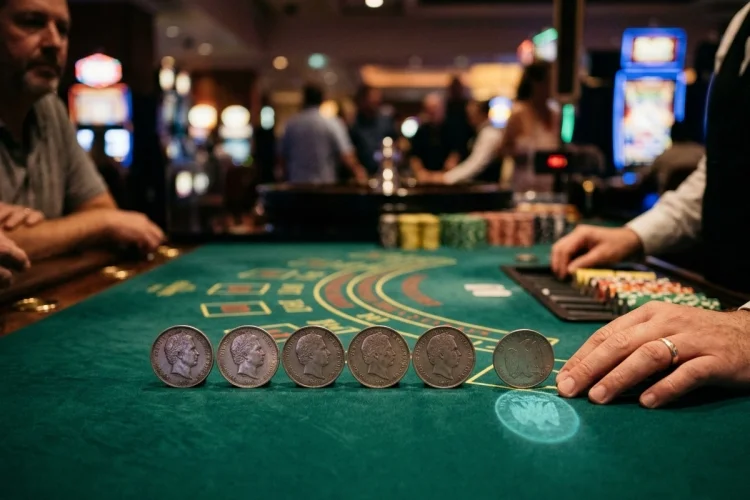
Imagine flipping a fair coin five times and getting heads every time. What would you expect next? Many people instinctively choose tails because it feels “due.” Yet if the coin is fair and every toss is independent, the next flip is still 50% heads and 50% tails.
That simple mistake captures The Gambler’s Fallacy, a cognitive bias that makes random streaks feel as though they must soon reverse.
It appears naturally in gambling, but the same thinking can influence financial choices, predictions, and everyday decisions whenever people try to find balance inside random sequences.
What Is the Gambler’s Fallacy?
The gambler’s fallacy is the mistaken belief that a random event becomes less likely simply because it has happened several times recently.
Suppose roulette lands on red five times. A person affected by this bias may believe black now has a higher chance of appearing because the wheel needs to “balance itself.”
If the spins are genuinely independant and the probability has not changed, the earlier results do not alter the next one.
Research commonly links this error to what psychologists and behavioral economists call the law of small numbers. People often expect a very short sample to resemble the long-run distribution more closely than randomness actually requires.
A fair coin should produce roughly half heads and half tails over a very large number of flips. That does not mean every group of ten flips needs to contain five of each.
Why Random Streaks Feel Wrong
Humans are extremely good at detecting patterns. Usually, that ability is useful.
If the same problem happens every Monday after a particular process begins, finding the pattern may help solve it. Random events create a different challenge because they can naturally generate clusters and streaks that look meaningful.
A sequence such as:
Heads – Heads – Heads – Heads – Heads
often feels less random than:
Heads – Tails – Heads – Tails – Tails
Yet both exact five-flip sequences have the same probability before the flips happen.
Research on perceptions of randomness suggests people often expect random sequences to alternate more frequently than genuine randomness does. This helps explain why long runs can look suspicious even when they are perfectly possible.
The mistake is expecting randomness to look neatly balanced in the short run.
Why “Due” Does Not Change Probability
The key concept is independence.
If one event does not affect another, the probability calculation starts fresh each time.
Take a fair coin. After ten consecutive heads, the next flip still has:
50% chance of heads
50% chance of tails
The probability of getting eleven heads from the beginning is extremely small. But once ten heads have already occured, those outcomes are history. The only question remaining is the probability of the next independent flip.
This distinction between the probability of an entire sequence and the probability of the next event causes a lot of confusion.
People may correctly recognize that ten heads in a row is unusual, then incorrectly conclude that tails has become more likely on flip eleven.
NBER uses the same coin example when explaining the bias: previous heads do not change the 50-50 probability of the next fair toss.
How the Bias Appears in Casino Decisions
Casino environments make streaks very visible.
Roulette displays previous winning numbers. Baccarat tables often show histories of Banker and Player results. Players may remember several losing spins or notice that a particular outcome has not appeared recently.
That information can create a strong feeling that something should happen next.
For example, imagine red has appeared seven times on an independent roulette sequence. Someone might increase a bet on black because “eight reds in a row would be ridiculous.”
But unusual does not mean impossible.
Laboratory research using roulette-style prediction tasks has repeatedly found that participants become more likely to predict a reversal after a run of the same outcome.
One study also found that betting amounts could increase during losing streaks, illustrating how pattern beliefs may interact with loss chasing.
This is where a simple misunderstanding of probablity can become expensive. A streak does not create a repayment schedule.
Lottery Players Show Similar Behavior
The bias is not limited to roulette or casino tables.
Lottery data provide an interesting real-world example.
Researchers Charles Clotfelter and Philip Cook examined Maryland daily lottery participation and found that betting on a particular number dropped sharply after that number had recently been drawn. Interest then gradually returned over time.
The pattern is consistent with people thinking, “That number just came out, so it probably will not appear again soon.”
But if the lottery process is independent and properly random, yesterday’s number does not become temporarily exhausted.
A number has no memory.
This is one reason random-number histories can be psychologically powerful while offering little useful predictive information.
Gambler’s Fallacy Is Not the Same as the Hot-Hand Belief
There is another bias that sounds almost opposite: the hot-hand fallacy.
The gambler’s fallacy says:
A streak should reverse.
The hot-hand belief says:
A streak should continue.
Someone watching four consecutive wins might therefore make two opposite mistakes. One person predicts a loss because the streak has lasted “too long,” while another predicts another win because the player is supposedly “hot.”
Research in financial markets has found evidence consistent with both types of thinking under different conditions. One study of individual trading data reported reversal expectations after shorter streaks and stronger continuation beliefs after longer ones.
The important lesson is not that every sequence must continue or reverse.
It is that a streak alone may provide much less information than our intuition wants it to.
Why Smart People Can Still Make the Mistake
Knowing basic mathematics does not automatically eliminate cognitive bias.
A PLOS ONE study involving college students produced an interesting finding: stronger use of the gambler’s-fallacy pattern was positively associated with some measures of cognitive ability and executive function while being negatively associated with affective decision-making performance.
That does not mean intelligence causes the bias.
It suggests the psychology may be more complecated than “people make this mistake because they cannot think logically.”
Humans naturally search for explanations. Sometimes sophisticated reasoning can even create convincing stories around patterns that are actually random.
The best defense is therefore not simply “think harder.” It is to identify whether the events are actually connected.
A Better Way to Think About Random Results
When you notice yourself thinking that an outcome is “due,” ask one simple question:
Does the previous result physically or mathematically change the next one?
If cards are being removed from a finite deck, earlier cards may genuinely alter later probabilities.
If a fair coin is flipped independently, earlier results do not.
That difference is crucial.
Rather than asking what has happened recently, identify the underlying process. Understand whether events are independent, whether probabilities change, and whether there is genuine evidence connecting one result with the next.
This turns decision-making away from emotional pattern recognition and toward the actual mechanism generating the outcome.
The Gambler’s Fallacy happens because people expect randomness to balance itself too quickly. Long streaks feel unusual, so the opposite result begins to feel “due,” even when the next independent event has exactly the same odds as before.
When evaluating a random sequence, focus on how the process works rather than recent outcomes. The next time a streak catches your attention, check the probability before trusting the pattern.